Home Blog Page 35

Let’s Talk About Cassian Murdering Those Dudes

0

The universe was introduced to Cassian Andor in Rogue One murdering an informant named Tivik, so the Empire would not capture the informant. Tivik had in injured arm, which disabled him from climbing to safety from closing Imperial Stormtroopers. If Tivik had been captured, much of the Rebel plans would have been exposed to find Jyn Erso.

Cassian’s actions are highly problematic legally (let alone morally). First, Cassian killed Stormtroopers who asked for his identification. The Stormtroopers only asked for Cassian’s identification, which is highly difficult to justify the use of lethal force as a response. However, the Stormtroopers did not have reasonable suspicion to stop Cassian, as he was not apparently breaking any laws. Perhaps Cassian could have reasonably believed his life was in danger based on past actions of Imperial Stormtroopers, but this would still push self-defense laws well past the norm.

Tivik posed no direct threat to Cassian’s life. Killing Tivik would meet the legal definition of murder, because Cassian killed Tivik with malice aforethought, because there was an “intent-to-kill.”

Tivik had knowledge that could have been fatal to the Rebellion. If the Empire had learned of Galen Erso’s actions, or the existence of Jyn Erso, the Rebels would not have been able to develop a plan to find Jyn and ultimately the Death Star plans. Unfortunately for Cassian, the necessity defense does not cover killing people.

The street fight on Jedha witnessed Cassian shooting one of Saw Gerrera’s “extreme rebels.” Gerrera’s freedom fighter had an explosive device that objectively looked like he was going to throw the explosive at the disabled hover tank. As Jyn Erso was hiding by the tank to protect herself from the fire between Gerrera’s men and Stormtroopers, Cassian could argue he killed Gerrera’s soldier in order to protect Jyn from being killed.

The Top Legal Geeks Blog Posts of 2016

0

Check out the countdown of our most popular posts published in 2016 from Number 10 to Number 1.

We had a great year, with three of our guest bloggers making the top ten, including one law student. The most read categories include Luke Cage, Captain America, Daredevil, Star Trek, and Star Wars.

On to the countdown…

Number 10

Iron Man’s Child Endangerment of Spider-Man

0
Tony Stark entered a new world of liability in Captain America Civil War. No, not a products liability case for building another murdering robot. No, not a 1983 action for holding super-heroes in a...

Number 9

What is the Duty to Warn about the Salt Monster on Planet M113?

2
The world began exploring the Final Frontier of Star Trek on September 8, 1966. To honor this anniversary, let’s explore the legal issues in The Man Trap. Star Trek began with the age-old problem many...

Number 8

Did Daredevil Adequately Prepare for the Punisher’s Trial?

0
Spoiler Warning: Do not read unless you have watched Daredevil season 2 episodes "Semper Fidelis" and "Guilty as Sin." Matt Murdock and Foggy Nelson represented Frank Castle in his trial that included 37 murder and 98...

Number 7

Did the Jury in Civil War 2 Nullify the Murder Charges Against Hawkeye?

1
Hawkeye murdered the Hulk in Civil War 2 issue 3. Issue 4 opens with a jury verdict in Federal Court of "Not Guilty." Was justice really served on Hawkeye? Did the jury acquit Clint...

A great guest blogger in Utah took one of the biggest legal issues from The Force Awakens for our sixth most read post in 2016. 

Number 6

Who Owns the Millennium Falcon?

0
In The Force Awakens, the Millennium Falcon starts out in the hands of Unkar Plutt, who stole it from the Irving Boys, who stole it from Gannis Ducain, who stole it from Han Solo,...

Number 5

I Ain’t Afraid of No Reboot!

1
I took my kids and my friend’s son to the new Ghostbusters yesterday. They all knew and loved the original Ghostbusters and were really looking forward to the new one. And not one of them...

The fourth most read post this year is by a JAG officer who helped with our Countdown to Rogue One in December. 

Number 4

The Death Star: That’s No Moon—Is it an Orbital War Crime?

1
The Empire’s prized planet-busting weapon was arguably the pinnacle of destructive technology in the Star Wars universe…at least until the First Order one-upped them with Starkiller Base. If Darth Vader had not sliced him in...

The third most read post is by a McGeorge law student who also participated in the Mock Trial of the Winter Soldier. 

Number 3

How Would You Defend Captain America After Marvel’s Civil War?

0
Let me start by saying that if the United States were to try and prosecute the most patriotic super hero of all time I would, after passing the state bar exam, jump at the...

Number 2

Does Luke Cage Have a Duty to Warn Attackers He’s Unbreakable?

1
Marvel’s Luke Cage on Netflix is excellent. The series has perhaps the most Easter Eggs from other Marvel stories, including Avengers, Iron Man 2, Jessica Jones, and Daredevil. There are wonderful homages to the Power...

Number 1

Why the Sokovia Accords are Unconstitutional

1
Captain America Civil War is an amazing super-hero movie. It is the model of how to have a large cast of characters in a film with action, humor, plot, and heart. The only thing...

Great to see Captain America and the US Constitution come in a strong first place. Thank you all for reading our blog in 2016. 

Our Review of 2016

0

2016 was a wild ride for the entire country. We take a moment to share our thoughts on all of the good of the past year, including the Mock Trial of the Winter Soldier at San Diego Comic Fest, an amazing time at San Diego Comic Con, our adventures at San Francisco Comic Con, and the best of science fiction and comics in 2016. We also share our thoughts on what did not go well and those we lost.

You can also listen on Stitcher

And Now on Google PlayListen on Google Play Music

Your Duty of Care to Santa Claus as an Invitee

0

People around the world leave milk and cookies out for Santa Claus, in exchange for gifts based upon their annual behavior. Children have extended written invitations through the US Mail for Santa Claus to visit them on Christmas Eve. Few of these homeowners likely consider whether Old Saint Nick is an invitee, a guest, and what is their duty of care to Father Christmas. Has anyone consulted with an attorney on their liability for injuries to Santa Claus?

For the entire population of California, be aware of the following: Everyone is responsible, not only for the result of his or her willful acts, but also for an injury occasioned to another by his or her want of ordinary care or skill in the management of his or her property or person, except so far as the latter has, willfully or by want of ordinary care, brought the injury upon himself or herself. Cal. Civ. Code § 1714.

The very act of leaving out treats such milk and cookies for Santa, and carrots for the reindeer, are an open invitation for Santa Claus to enter your home. Moreover, providing milk and cookies in exchange for Christmas gifts contingent on good conduct, makes Santa Claus a “business visitor.” This legal status is for those “invited or permitted to enter or remain on land in the possession of another for a purpose directly or indirectly connected with business dealings between them.” O’Keefe v. S. End Rowing Club, 64 Cal. 2d 729, 735, (1966). This means Santa Claus is an “invitee” under the law in many states, because the purpose of Santa’s visit “involves some matter of mutual business interest or advantage,” specially leaving presents in exchange for milk and cookies. Id.

Everyone leaving out hot coco, milk, cookies, and carrots owe Santa Claus a duty to Santa Claus to exercise reasonable care in maintaining their premises in a safe condition so as not to injure Santa Claus or his reindeer. Ashley v. Jones, 126 Cal. App. 2d 328, 332 (1954), citing Butcher v. Queen City Iron & Metal Co., 99 Cal.App.2d 25. This means tripping hazards should be removed, pets secured so they will not attack Santa Claus, and that milk has not passed its expiration date, plus other simple safety standards that can be identified in a home inspection. Moreover, there should be adequate lighting on the house with Christmas lights per FAA regulations, to ensure a safe landing for Santa.

Landlords of apartment complexes should also take special notice. Landlords should take reasonable care in making safe all common areas of apartments. Lessor’s have an obligation for the safety of “all approaches and entrances, yards, and any other parts of the premises maintained for the benefit of the tenants within the purposes of the lease.” Sockett v. Gottlieb, 187 Cal. App. 2d 760, 763 (1960). Case law has held that, “A violation of that duty, in the absence of contributory negligence, subjects the landlord to liability to a tenant’s guest or invitee injured while lawfully on the premises within the scope of his invitation, and as a proximate result of such violation.” Id. For a landlord to be found liable, there must be evidence of knowledge of an unsafe or defective condition, or the failure to exercise ordinary care in correcting it, or such knowledge of a defect would have been learned if the landlord exercised ordinary care. Id.

Santa Claus will soon be entering homes to leave gifts on his annual business venture spreading Christmas Cheer. Homeowners, renters, landlords, and property management professionals, should be aware that they could be responsible for injuries to Santa Claus if they fail to use ordinary care to remove hazards for their living rooms and roofs. Remember, no one should have to call their lawyer on Christmas morning for injuries sustained by Santa Claus.

Conscripting Galen Erso to Build the Death Star

0

The opening scene of Rogue One is the forced conscription at gunpoint of Galen Erso by Director Orson Krennic and his Death Troopers. The work on the Death Star was stalled and Erso was needed to complete the project.

Was that legal?

The United States history with drafting citizens for military service offers a comparison for conscripting citizens for military service.

Civil War case law addressed the first draft cases in the United States. One Court described conscription as follows:

A conscript is one taken by lot from the conscription (or enrollment) list, “and compelled to serve as a soldier or sailor.” (Web. Dic. verb. “conscript.”) The power to raise an army by conscription or coercion (the words are nearly synonymous) rests alone on the idea that the power is unlimited, as to the means to be used, as well as to the numbers of which it may be composed. If there was no other power or principle in the instrument to be affected in its operation by such a view, there would be force in the idea. But the Constitution must be administered so that the whole may stand in full force, unimpaired by any particular portion.

Kneedler v. Lane, 1863 Pa. LEXIS 268, at *66 (Nov. 9, 1863).

Galen Erso’s service was needed to complete the Death Star. Erso recognized the weapon was being built to ensure peace through terror. Moreover, most people drafted were through the mail, not at gunpoint. Furthermore, U.S. citizens have been drafted when they strongly disagreed with the war they were being drafted to fight in. As the US Supreme Court said on this issue:

Other fields of legal obligation aside, it is undoubted that the nature of conscription, much less war itself, requires the personal desires and perhaps the dissenting views of those who must serve to be subordinated in some degree to the pursuit of public purposes.

Gillette v. United States, 401 U.S. 437, 459 (1971).

The US Selective Service Act allows for retired military service members to be recalled to service for up to twenty-four months:

Until July 1, 1953, and subject to the limitations imposed by section 2 of the Selective Service Act of 1948, as amended, the President shall be authorized to order into the active military or naval service of the United States for a period of not to exceed twenty-four consecutive months, with or without their consent, any or all members and units of any or all Reserve components of the Armed Forces of the United States and retired personnel of the Regular Armed Forces.

50 U.S.C.S. § 3819.

Galen Erso had left the military and was objectively opposed to building the Death Star. That was clearly evidenced by moving his family to a remote farm, complete with early warning systems and a bunker to hide his daughter. However, the concept of drafting a retired service person is not unheard of for national defense. That being said, Director Krennic’s methods are highly problematic with threatening Erso at blaster-point to kidnap his entire family.

The Death Troopers shooting Lyra Erso raises multiple other issues. Lyra arguably had a defense of others for Galen, because multiple Death Troopers had weapons pointed at Galen. However, the Death Troopers could argue they were within their rights to 1) legally draft Galen and 2) acted in self-defense after Lyra drew a weapon at them. However, this would then require an Imperial Court to recognize kidnapping families at gunpoint is not forced labor, but a legitimate way to draft service members. A galaxy far, far, away might accept that, but not this one.

Galen Erso worked on the Death Star far beyond twenty-four months. As evidenced in his holographic recording, this long tenure could be attributed to Galen’s working on the Death Star project in order to sabotage it. The Empire likely did not allow for conscripts to leave the service, but the Empire should have reconsidered their “enhanced drafting” methods.

Calling Law Students for X-Men Mock Hearing at San Diego Comic Fest

0

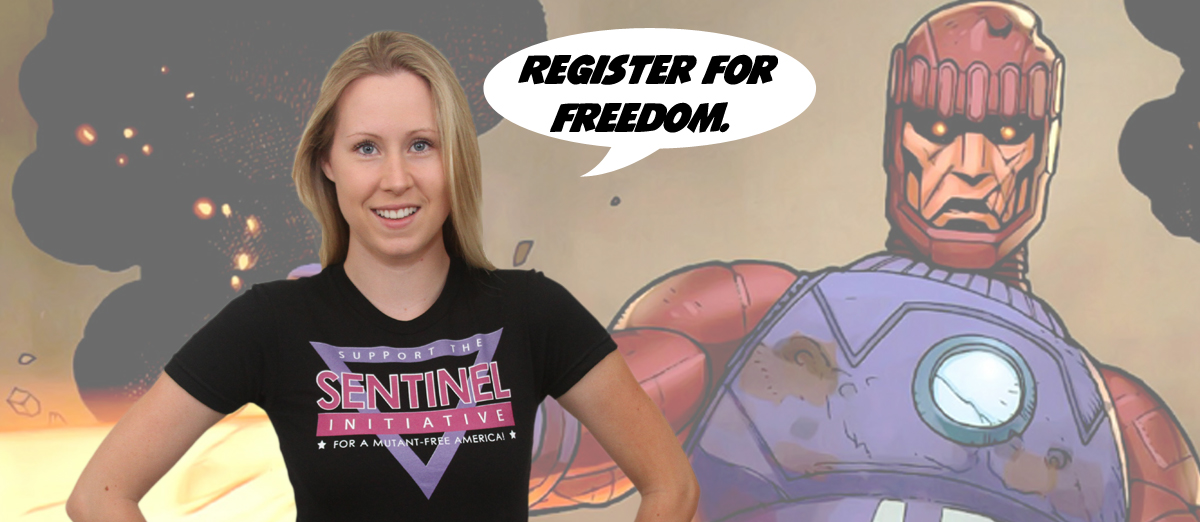
We are proud to announce our second mock trial for San Diego Comic Fest, to be held over President’s Day weekend, February 17-20, 2017, at the Four Points by Sheraton. Our new program is a mock hearing to bring an injunction to prohibit the use of Sentinels against US Citizens. We are seeking two law students to represent a Mutant Rights Group and two law students arguing for the US Government’s use of Sentinels.

X-Men Days of Future Past depicted the US Government creating Sentinels that could identify US Citizens who were “Mutants” based on their DNA. The Sentinels would then immediately kill anyone who was a mutant.

The fictional President of the United States has issued Executive Order 09101963 after a terrorist attack by the Brotherhood of Mutants:

Authorizing the Secretary of Defense to Prescribe Mutant Areas

Whereas the successful defense of the United States against the Mutant Threat requires every possible protection against espionage and against sabotage to national-defense material, national-defense premises, and national-defense utilities.

Now, therefore, by virtue of the authority vested in me as President of the United States, and Commander in Chief of the Army and Navy, I hereby authorize and direct the Secretary of Defense, and the Military Commanders whom he may from time to time designate, whenever he or any designated Commander deems such action necessary or desirable, to prescribe military areas in such places and of such extent as he or the appropriate Military Commander may determine, from which any or all persons may be excluded, and with respect to which, the right of any person to enter, remain in, or leave shall be subject to whatever restrictions the Secretary of Defense or the appropriate Military Commander may impose in his discretion. The Secretary of Defense is hereby authorized to provide for residents of any such area who are excluded therefrom, such transportation, food, shelter, and other accommodations as may be necessary, in the judgment of the Secretary of Defense or the said Military Commander, and until other arrangements are made, to accomplish the purpose of this order. The designation of military areas in any region or locality shall supersede designations of prohibited and restricted areas by the Attorney General.

I hereby further authorize and direct the Secretary of Defense and the said Military Commanders to take such other steps as he or the appropriate Military Commander may deem advisable to enforce compliance with the restrictions applicable to each Military area hereinabove authorized to be designated, including the use of Sentinels, Federal troops and other Federal Agencies, with authority to accept assistance of state and local agencies.

I hereby further authorize and direct all Executive Departments, independent establishments and other Federal Agencies, to assist the Secretary of Defense or the said Military Commanders in carrying out this Executive Order, including the furnishing of medical aid, hospitalization, food, clothing, transportation, use of land, shelter, and other supplies, equipment, utilities, facilities, and services.

This order shall not be construed as limiting or modifying the duty and responsibility of the Federal Bureau of Investigation, with respect to the investigation of alleged acts of sabotage or the duty and responsibility of the Attorney General and the Department of Justice, prescribing regulations for the conduct and control of Mutant enemies, except as such duty and responsibility is superseded by the designation of military areas hereunder.

The Secretary of Defense designated that anyone who has the Mutant gene be registered to ensure national security in compliance with Executive Order 09101963. All unregistered Mutants are deemed a threat to the United States. Sentinels have shoot to kill orders for all unregistered mutants in order to protect national defense.

Attorneys representing a Mutant Rights Group have brought an injunction in Federal Court to prohibit the registration of Mutants and the use of Sentinels to kill US Citizens pursuant to Federal Rule of Civil Procedure Rule 65. The Mutant Rights Group must show: (1) they are likely to succeed on the merits; (2) they plaintiffs are likely to suffer irreparable harm in the absence of injunctive relief; (3) the balance of the equities tips in its favor; and (4) an injunction is in the public interest.

The Plaintiffs arguments can include that the use of Sentinels:

1) Is race-based discrimination because of the Plaintiffs’ DNA and will not survive strict scrutiny;

2) Is a gross violation of the 5th Amendment Right to not deprive anyone of their life without due process of law;

3) Is a violation of the 4th Amendment warrant requirement for probable cause;

4) Is a violation of the 6th Amendment right to a trial in any criminal prosecution; and

5) Is a violation of the 8th Amendment right against cruel and unusual punishment.

The Government argument is that the Constitution does not apply to Mutants, because they are not Homo sapiens, thus not “persons” under the law. Human beings do not have wings, fur, blue skin, or fangs. Even if Homo superiors were “human” to be considered a person under the law, strict scrutiny has been met, because of the dangers Mutants pose to national security. Mutants have the power to control minds, destroy buildings, and are a clear and present danger to all human life. Many mutants are indistinguishable from human beings, thus justifying the need to register Mutants for the safety of the humanity. The only reason for a Mutant to not be registered is that they are an enemy of the state.

Format of argument: the Plaintiffs will have 20 minutes to make their arguments. The law students should divide the work 50/50 between registration of mutants and use of Sentinels. Arguments can focus on the text of Executive Order authorizing the Sentinel program and the elements to grant an injunction. A motion will be due on February 1, 2017 outlining the student arguments with any case or statutory authority. The Plaintiffs can file a reply brief by February 15, 2017.

The Government will also have 20 minutes for their arguments on the Constitutionality of the Sentinel program and that the Plaintiff’s motion should be denied.The law students should divide the work 50/50. One law student should defend the registration of Mutants and the other the right to use Sentinels on Mutants. The Government’s opposition brief is due on February 8, 2017.

The Plaintiffs will have a five-minute rebuttal to the Government’s arguments.

Errata or supplemental material will be issued based on requests from the law students for support of factual arguments or supporting case law.

All motions will be posted on The Legal Geeks prior to the hearing at San Diego Comic Fest.

We currently have four law students signed up to participate. Others are welcome to sign up as an alternate in the event a student cannot participate. 

That’s No Moon, it the Imaginary Worlds Podcast on the Death Star

0

Judge Matthew Sciarrino and I had the privilege of being guests on the Imaginary Worlds podcast celebrating Star Wars. We each were asked about the famous discussion in Clerks about independent contractors killed on the second Death Star at the Battle of Endor. We also discussed war crimes, employee safety, and many other issues from Star Wars.

A big thank you to Eric Monlinsky for inviting me to participate for the second time to discuss the legal issues in a galaxy, far, far, away.