Check out the countdown of our most popular posts published in 2016 from Number 10 to Number 1.
We had a great year, with three of our guest bloggers making the top ten, including one law student. The most read categories include Luke Cage, Captain America, Daredevil, Star Trek, and Star Wars.
Tony Stark entered a new world of liability in Captain America Civil War. No, not a products liability case for building another murdering robot. No, not a 1983 action for holding super-heroes in a...
The world began exploring the Final Frontier of Star Trek on September 8, 1966. To honor this anniversary, let’s explore the legal issues in The Man Trap.
Star Trek began with the age-old problem many...
Spoiler Warning: Do not read unless you have watched Daredevil season 2 episodes "Semper Fidelis" and "Guilty as Sin."
Matt Murdock and Foggy Nelson represented Frank Castle in his trial that included 37 murder and 98...
Hawkeye murdered the Hulk in Civil War 2 issue 3. Issue 4 opens with a jury verdict in Federal Court of "Not Guilty." Was justice really served on Hawkeye? Did the jury acquit Clint...
In The Force Awakens, the Millennium Falcon starts out in the hands of Unkar Plutt, who stole it from the Irving Boys, who stole it from Gannis Ducain, who stole it from Han Solo,...
I took my kids and my friend’s son to the new Ghostbusters yesterday. They all knew and loved the original Ghostbusters and were really looking forward to the new one. And not one of them...
The Empire’s prized planet-busting weapon was arguably the pinnacle of destructive technology in the Star Wars universe…at least until the First Order one-upped them with Starkiller Base.
If Darth Vader had not sliced him in...
Let me start by saying that if the United States were to try and prosecute the most patriotic super hero of all time I would, after passing the state bar exam, jump at the...
Marvel’s Luke Cage on Netflix is excellent. The series has perhaps the most Easter Eggs from other Marvel stories, including Avengers, Iron Man 2, Jessica Jones, and Daredevil. There are wonderful homages to the Power...
Captain America Civil War is an amazing super-hero movie. It is the model of how to have a large cast of characters in a film with action, humor, plot, and heart. The only thing...
2016 was a wild ride for the entire country. We take a moment to share our thoughts on all of the good of the past year, including the Mock Trial of the Winter Soldier at San Diego Comic Fest, an amazing time at San Diego Comic Con, our adventures at San Francisco Comic Con, and the best of science fiction and comics in 2016. We also share our thoughts on what did not go well and those we lost.
With all the moving pieces in Rogue One, don’t feel bad if you came away a little confused about how exactly the Rebel Alliance is composed. After all, even Jyn Erso had trouble making sense of it when she first arrived at the Rebel base. In the original trilogy films the good guys were really easy to tell apart from the bad ones—partly because of the Empire’s affinity for white, black, and various tones of grey. Rogue One muddied those waters.
Someone please tell Anakin to shove it.
In the original trilogy, the Rebellion was portrayed as a singular entity: a rag tag force that ducked, bobbed, and weaved around the galaxy. Rogue One changed that by showing us a fragile Rebel Alliance beset by divisiveness and extremist factions.
In this way Rogue One mirrors the real world, as conflicts have rarely been limited to two factions duking it out on the battlefield. The US experienced this in its own history, with irregular forces playing a role in almost every conflict from the American Revolution to operations in Afghanistan. Militias, extremists, and other irregular military forces often present complications that extend far past any single battle. Most recently, the “War on Terror” and Syrian Civil War have brought these complications into sharp focus as nations grapple with how to deal with different types of fighters.
Rogue One presents many of those same issues. While the larger Rebel Alliance struggles to throw off the Empire’s yoke, splinter elements like Saw Gerrera’s ruthless militia frustrate their efforts. The interplay between the Alliance and Saw’s forces poses an interesting question: What sort of legal status do the fighters in Rogue One have?
Darth Vader demonstrates his own method of determining one’s combatant status.
Fortunately, we don’t need K-2SO’s skills in strategic analysis to answer this one. Under the law of war, those who take direct part in fighting are considered combatants. But not all combatants are created equal under the law of war. “Privileged” (or “lawful”) combatants are those who meet certain traditional criteria established, in part, by The Hague and Geneva Conventions. Those requirements include (1) wearing a fixed distinctive sign or uniform; (2) operating under a military command; (3) carrying arms openly; and (4) abiding by the laws of war. Someone who fights but does not meet one or more of those requirements is considered an “unprivileged” (or “unlawful”) combatant. There is a big distinction between the two, as “privileged” combatants are entitled to prisoner of war (POW) status if captured and bear no criminal responsibility for acts within the bounds of the law of war.
Luckily for the Rebels, they fit the criteria for privileged combatants. First, while they may lack the polished white armor of Imperial stormtroopers (or the supremely badass Death Troopers’ black kits), the Rebels wear their own brand of uniform. We see a mix of these throughout Star Wars, from the iconic blaze orange flight suits of Red and Gold squadrons to the dapper button down and vest-wearing fleet troopers. Many Rebel pilots’ helmets are also emblazoned with the Rebellion’s iconic starbird symbol.
The latest in Rebel pilot and fleet trooper fashion.
The Rebel Special Forces (SpecForces) Soldiers who volunteered for the Scarif infiltration may not have REBELLION stitched on their backs, but they were still equipped in uniforms. Much like their brethren on Han Solo’s Endor strike team, their uniforms were meant to be utilitarian. Their shirts, vests, cargo pants, and combat boots are roughly similar to each other. The Continental Army faced similar circumstances during the American Revolution. American troops generally wore similar uniforms, but not every soldier had access to the same supplies, which sometimes resulted in ragtag-looking battle formations. As a whole, the Alliance’s uniforms are distinctive, which serves an important underlying purpose: It helps distinguish them from civilians on the battlefield.
Saw Gerrera’s militia force on Jedha provides a stark contrast. His forces forgo any type of uniform. This is best exemplified in the scene where Saw’s forces ambush an Imperial tank in the middle of Jedha City. His forces dress in clothing similar to Jedha civilians, wearing no type of uniform or distinctive insignia. Doing this surprises the Imperial troops when they hit the tank. After the ambush they again take advantage of their civilian appearance to melt back into the civilian population as Imperial reinforcements arrive.
Second, Alliance fighters operate under a military command. The Rebels in Rogue One have a clearly established chain of command, from lower enlisted troops like Corporal Bistan (everyone’s favorite space monkey door gunner on the U-Wing) all the way up to officers like crotchety General Draven and loveable Admiral Raddus. While one can certainly question the Alliance’s military decision-making (ahem, Admiral Raddus—we all saw you cowboy off to Scarif), there is no question that their forces are organized in roughly a traditional command structure. Those in authority maintain control over their forces and bear responsibility for their actions.
On the other hand, Saw’s forces are merely a loosely cobbled collection of denizens aligned around a similar goal. Saw is undoubtedly the leader of the group, but his position bears little resemblance to the type of military command contemplated by the law of war. To Saw Gerrera, this presents an advantage—the lack of rigid military command, control, and accountability gives his forces moral and tactical flexibility to more quickly achieve their objectives.
Besmirching Saw like that will get you sent straight to the bor gullet for a slimy tentacle hug.
Third, Alliance troops carry their arms openly. The requirement that privileged combatants carry arms openly helps distinguish them from civilians, just as with the uniform requirement. In Rogue One, the Rebel SpecForces on Scarif openly carried blasters as they maneuvered, fired, and displaced. The same went for the unfortunate Rebel troopers who rushed to download the Death Star plans before getting cut to ribbons by Darth Vader in quite possibly the most amazing Star Wars scene ever.
In comparison, Saw’s band of fighters only did so when it suited them. While some of his men are seen openly armed during the prisoner exchange with Bodhi, those involved in the Jedha City ambush conceal their arms until the last second. This quickly causes chaos, as the Imperials have trouble telling combatants apart from civilians in the fray. This confusion unnecessarily put civilians in harm’s way.
The Tin Man wanted a heart…poor K-2SO just wanted a shiny new Blastech blaster pistol.
Finally, although some of their actions were questionable, the Alliance abides by the law of war throughout Rogue One. For instance, they do not kill indiscriminately or target civilians. The Rebels contain their strikes to legitimate military targets, using force only when necessary. Conversely, Saw Gerrera’s forces appear to be at peace with violating the law of war if it helped achieve their objectives. The Jedha City ambush is a prime example, as many of Saw’s men disguise themselves as civilians before firing on stormtroopers. Under the Geneva Conventions Additional Protocol I, feigning protected civilian status to kill enemy combatants is considered perfidy, a treacherous act and breach of the law of war. Similarly, Saw’s use of the tentacled bor gullet creature to interrogate Bodhi Rook arguably constituted torture, which would violate tenets of international law such as the 1984 Convention Against Torture.
Ah, the face of an unprivileged combatant that only a mother could love.
Unlike Rebel Alliance soldiers, Gerrera’s band bears a striking resemblance to groups like the World War II French resistance groups Franc-Tireur and Francs-Tireurs et Partisans. These groups operated in small cells, wore no uniforms, and aimed to disrupt German occupation of France at all costs, much like Saw’s forces sought to do on Jedha. In the post-World War II Nuremberg Trials, many of the partisan fighters aligned with those groups were found to be unprivileged combatants. Saw’s forces would likely be treated the same given their composition.
In contrast, Rebel Alliance soldiers are classified as privileged combatants. This distinction is critically important to the Alliance because of the protections privileged combatants enjoy under the law. First and foremost, any captured Alliance soldiers would be entitled to POW status and granted the protections outlined in the Third Geneva Convention. Without this sort of protection captured Alliance forces would face a grim fate upon capture, including inhumane treatment, neglect, and summary execution. Although POW status would not magically prevent the Empire from committing abuses, it is nonetheless a vital right of lawful combatants.
Additionally, as lawful combatants, Alliance forces would bear no criminal responsibility for killing enemy personnel or destroying enemy property, provided the acts were done within the bounds of the law of war. Given the Alliance operations we see in Rogue One, this protection is critical. For example, Alliance pilots could not be held responsible for killing Imperial forces during their bombing run on Eadu. Similarly, had Scarif not been swatted by the Death Star, the Rebel SpecForces would be immune for their destructive efforts on the planet.
In the end, the Alliance’s concern for distinguishing itself from Saw’s band of fanatics goes far beyond the need for legal protections. Much like American forces during the Revolution, the Alliance’s struggle for legitimacy was just as important as any of their combat operations. Splinter factions like Saw Gerrera’s severely undermine the larger cause, as their extreme tactics helped the Empire’s effort in casting the Rebellion as a collection of terrorists and insurrectionists who deserve no quarter. It is therefore essential that the Alliance distance itself from those kinds of splinter groups by conducting its combat operations appropriately—even if the bad guys are led by a psychopathic Sith lord and his youngling-murdering half robot apprentice.
People around the world leave milk and cookies out for Santa Claus, in exchange for gifts based upon their annual behavior. Children have extended written invitations through the US Mail for Santa Claus to visit them on Christmas Eve. Few of these homeowners likely consider whether Old Saint Nick is an invitee, a guest, and what is their duty of care to Father Christmas. Has anyone consulted with an attorney on their liability for injuries to Santa Claus?
For the entire population of California, be aware of the following: Everyone is responsible, not only for the result of his or her willful acts, but also for an injury occasioned to another by his or her want of ordinary care or skill in the management of his or her property or person, except so far as the latter has, willfully or by want of ordinary care, brought the injury upon himself or herself. Cal. Civ. Code § 1714.
The very act of leaving out treats such milk and cookies for Santa, and carrots for the reindeer, are an open invitation for Santa Claus to enter your home. Moreover, providing milk and cookies in exchange for Christmas gifts contingent on good conduct, makes Santa Claus a “business visitor.” This legal status is for those “invited or permitted to enter or remain on land in the possession of another for a purpose directly or indirectly connected with business dealings between them.” O’Keefe v. S. End Rowing Club, 64 Cal. 2d 729, 735, (1966). This means Santa Claus is an “invitee” under the law in many states, because the purpose of Santa’s visit “involves some matter of mutual business interest or advantage,” specially leaving presents in exchange for milk and cookies. Id.
Everyone leaving out hot coco, milk, cookies, and carrots owe Santa Claus a duty to Santa Claus to exercise reasonable care in maintaining their premises in a safe condition so as not to injure Santa Claus or his reindeer. Ashley v. Jones, 126 Cal. App. 2d 328, 332 (1954), citing Butcher v. Queen City Iron & Metal Co., 99 Cal.App.2d 25. This means tripping hazards should be removed, pets secured so they will not attack Santa Claus, and that milk has not passed its expiration date, plus other simple safety standards that can be identified in a home inspection. Moreover, there should be adequate lighting on the house with Christmas lights per FAA regulations, to ensure a safe landing for Santa.
Landlords of apartment complexes should also take special notice. Landlords should take reasonable care in making safe all common areas of apartments. Lessor’s have an obligation for the safety of “all approaches and entrances, yards, and any other parts of the premises maintained for the benefit of the tenants within the purposes of the lease.” Sockett v. Gottlieb, 187 Cal. App. 2d 760, 763 (1960). Case law has held that, “A violation of that duty, in the absence of contributory negligence, subjects the landlord to liability to a tenant’s guest or invitee injured while lawfully on the premises within the scope of his invitation, and as a proximate result of such violation.” Id. For a landlord to be found liable, there must be evidence of knowledge of an unsafe or defective condition, or the failure to exercise ordinary care in correcting it, or such knowledge of a defect would have been learned if the landlord exercised ordinary care. Id.
Santa Claus will soon be entering homes to leave gifts on his annual business venture spreading Christmas Cheer. Homeowners, renters, landlords, and property management professionals, should be aware that they could be responsible for injuries to Santa Claus if they fail to use ordinary care to remove hazards for their living rooms and roofs. Remember, no one should have to call their lawyer on Christmas morning for injuries sustained by Santa Claus.
The opening scene of Rogue One is the forced conscription at gunpoint of Galen Erso by Director Orson Krennic and his Death Troopers. The work on the Death Star was stalled and Erso was needed to complete the project.
Was that legal?
The United States history with drafting citizens for military service offers a comparison for conscripting citizens for military service.
Civil War case law addressed the first draft cases in the United States. One Court described conscription as follows:
A conscript is one taken by lot from the conscription (or enrollment) list, “and compelled to serve as a soldier or sailor.” (Web. Dic. verb. “conscript.”) The power to raise an army by conscription or coercion (the words are nearly synonymous) rests alone on the idea that the power is unlimited, as to the means to be used, as well as to the numbers of which it may be composed. If there was no other power or principle in the instrument to be affected in its operation by such a view, there would be force in the idea. But the Constitution must be administered so that the whole may stand in full force, unimpaired by any particular portion.
Kneedler v. Lane, 1863 Pa. LEXIS 268, at *66 (Nov. 9, 1863).
Galen Erso’s service was needed to complete the Death Star. Erso recognized the weapon was being built to ensure peace through terror. Moreover, most people drafted were through the mail, not at gunpoint. Furthermore, U.S. citizens have been drafted when they strongly disagreed with the war they were being drafted to fight in. As the US Supreme Court said on this issue:
Other fields of legal obligation aside, it is undoubted that the nature of conscription, much less war itself, requires the personal desires and perhaps the dissenting views of those who must serve to be subordinated in some degree to the pursuit of public purposes.
Gillette v. United States, 401 U.S. 437, 459 (1971).
The US Selective Service Act allows for retired military service members to be recalled to service for up to twenty-four months:
Until July 1, 1953, and subject to the limitations imposed by section 2 of the Selective Service Act of 1948, as amended, the President shall be authorized to order into the active military or naval service of the United States for a period of not to exceed twenty-four consecutive months, with or without their consent, any or all members and units of any or all Reserve components of the Armed Forces of the United States and retired personnel of the Regular Armed Forces.
50 U.S.C.S. § 3819.
Galen Erso had left the military and was objectively opposed to building the Death Star. That was clearly evidenced by moving his family to a remote farm, complete with early warning systems and a bunker to hide his daughter. However, the concept of drafting a retired service person is not unheard of for national defense. That being said, Director Krennic’s methods are highly problematic with threatening Erso at blaster-point to kidnap his entire family.
The Death Troopers shooting Lyra Erso raises multiple other issues. Lyra arguably had a defense of others for Galen, because multiple Death Troopers had weapons pointed at Galen. However, the Death Troopers could argue they were within their rights to 1) legally draft Galen and 2) acted in self-defense after Lyra drew a weapon at them. However, this would then require an Imperial Court to recognize kidnapping families at gunpoint is not forced labor, but a legitimate way to draft service members. A galaxy far, far, away might accept that, but not this one.
Galen Erso worked on the Death Star far beyond twenty-four months. As evidenced in his holographic recording, this long tenure could be attributed to Galen’s working on the Death Star project in order to sabotage it. The Empire likely did not allow for conscripts to leave the service, but the Empire should have reconsidered their “enhanced drafting” methods.
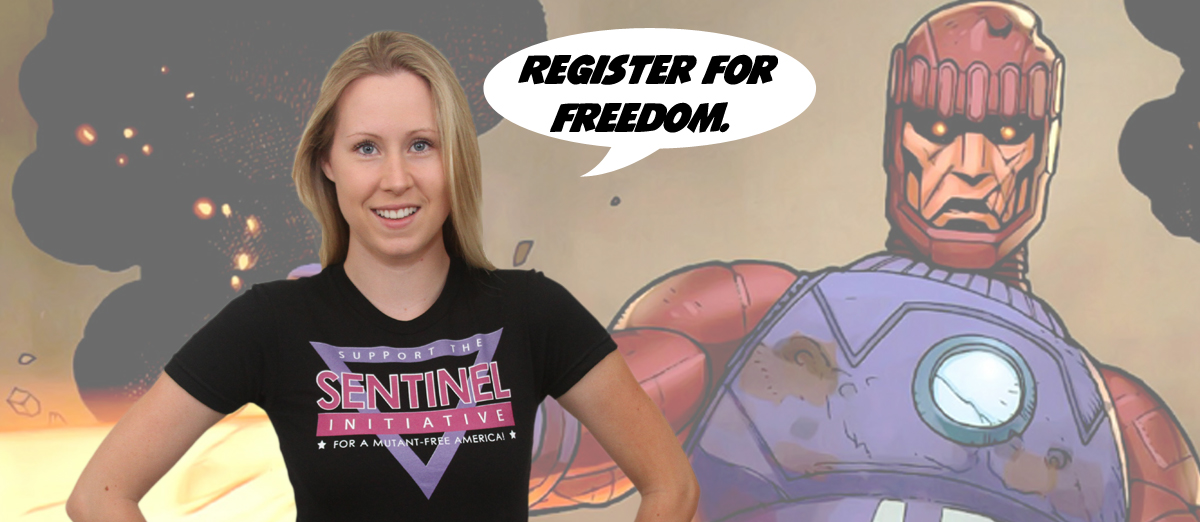
We are proud to announce our second mock trial for San Diego Comic Fest, to be held over President’s Day weekend, February 17-20, 2017, at the Four Points by Sheraton. Our new program is a mock hearing to bring an injunction to prohibit the use of Sentinels against US Citizens. We are seeking two law students to represent a Mutant Rights Group and two law students arguing for the US Government’s use of Sentinels.
X-Men Days of Future Past depicted the US Government creating Sentinels that could identify US Citizens who were “Mutants” based on their DNA. The Sentinels would then immediately kill anyone who was a mutant.
The fictional President of the United States has issued Executive Order 09101963 after a terrorist attack by the Brotherhood of Mutants:
Authorizing the Secretary of Defense to Prescribe Mutant Areas
Whereas the successful defense of the United States against the Mutant Threat requires every possible protection against espionage and against sabotage to national-defense material, national-defense premises, and national-defense utilities.
Now, therefore, by virtue of the authority vested in me as President of the United States, and Commander in Chief of the Army and Navy, I hereby authorize and direct the Secretary of Defense, and the Military Commanders whom he may from time to time designate, whenever he or any designated Commander deems such action necessary or desirable, to prescribe military areas in such places and of such extent as he or the appropriate Military Commander may determine, from which any or all persons may be excluded, and with respect to which, the right of any person to enter, remain in, or leave shall be subject to whatever restrictions the Secretary of Defense or the appropriate Military Commander may impose in his discretion. The Secretary of Defense is hereby authorized to provide for residents of any such area who are excluded therefrom, such transportation, food, shelter, and other accommodations as may be necessary, in the judgment of the Secretary of Defense or the said Military Commander, and until other arrangements are made, to accomplish the purpose of this order. The designation of military areas in any region or locality shall supersede designations of prohibited and restricted areas by the Attorney General.
I hereby further authorize and direct the Secretary of Defense and the said Military Commanders to take such other steps as he or the appropriate Military Commander may deem advisable to enforce compliance with the restrictions applicable to each Military area hereinabove authorized to be designated, including the use of Sentinels, Federal troops and other Federal Agencies, with authority to accept assistance of state and local agencies.
I hereby further authorize and direct all Executive Departments, independent establishments and other Federal Agencies, to assist the Secretary of Defense or the said Military Commanders in carrying out this Executive Order, including the furnishing of medical aid, hospitalization, food, clothing, transportation, use of land, shelter, and other supplies, equipment, utilities, facilities, and services.
This order shall not be construed as limiting or modifying the duty and responsibility of the Federal Bureau of Investigation, with respect to the investigation of alleged acts of sabotage or the duty and responsibility of the Attorney General and the Department of Justice, prescribing regulations for the conduct and control of Mutant enemies, except as such duty and responsibility is superseded by the designation of military areas hereunder.
The Secretary of Defense designated that anyone who has the Mutant gene be registered to ensure national security in compliance with Executive Order 09101963. All unregistered Mutants are deemed a threat to the United States. Sentinels have shoot to kill orders for all unregistered mutants in order to protect national defense.
Attorneys representing a Mutant Rights Group have brought an injunction in Federal Court to prohibit the registration of Mutants and the use of Sentinels to kill US Citizens pursuant to Federal Rule of Civil Procedure Rule 65. The Mutant Rights Group must show: (1) they are likely to succeed on the merits; (2) they plaintiffs are likely to suffer irreparable harm in the absence of injunctive relief; (3) the balance of the equities tips in its favor; and (4) an injunction is in the public interest.
The Plaintiffs arguments can include that the use of Sentinels:
1) Is race-based discrimination because of the Plaintiffs’ DNA and will not survive strict scrutiny;
2) Is a gross violation of the 5th Amendment Right to not deprive anyone of their life without due process of law;
3) Is a violation of the 4th Amendment warrant requirement for probable cause;
4) Is a violation of the 6th Amendment right to a trial in any criminal prosecution; and
5) Is a violation of the 8th Amendment right against cruel and unusual punishment.
The Government argument is that the Constitution does not apply to Mutants, because they are not Homo sapiens, thus not “persons” under the law. Human beings do not have wings, fur, blue skin, or fangs. Even if Homo superiors were “human” to be considered a person under the law, strict scrutiny has been met, because of the dangers Mutants pose to national security. Mutants have the power to control minds, destroy buildings, and are a clear and present danger to all human life. Many mutants are indistinguishable from human beings, thus justifying the need to register Mutants for the safety of the humanity. The only reason for a Mutant to not be registered is that they are an enemy of the state.
Format of argument: the Plaintiffs will have 20 minutes to make their arguments. The law students should divide the work 50/50 between registration of mutants and use of Sentinels. Arguments can focus on the text of Executive Order authorizing the Sentinel program and the elements to grant an injunction. A motion will be due on February 1, 2017 outlining the student arguments with any case or statutory authority. The Plaintiffs can file a reply brief by February 15, 2017.
The Government will also have 20 minutes for their arguments on the Constitutionality of the Sentinel program and that the Plaintiff’s motion should be denied.The law students should divide the work 50/50. One law student should defend the registration of Mutants and the other the right to use Sentinels on Mutants. The Government’s opposition brief is due on February 8, 2017.
The Plaintiffs will have a five-minute rebuttal to the Government’s arguments.
Errata or supplemental material will be issued based on requests from the law students for support of factual arguments or supporting case law.
All motions will be posted on The Legal Geeks prior to the hearing at San Diego Comic Fest.
We currently have four law students signed up to participate. Others are welcome to sign up as an alternate in the event a student cannot participate.
Judge Matthew Sciarrino and I had the privilege of being guests on the Imaginary Worlds podcast celebrating Star Wars. We each were asked about the famous discussion in Clerks about independent contractors killed on the second Death Star at the Battle of Endor. We also discussed war crimes, employee safety, and many other issues from Star Wars.
A big thank you to Eric Monlinsky for inviting me to participate for the second time to discuss the legal issues in a galaxy, far, far, away.