The Empire’s Stormtroopers are emissaries of fear to subjugate civilian populations. However, Stormtrooper armor appears to have multiple fatal flaws for surviving blunt force trauma from melee weapons, arrows, and rocks.
Attackers with sticks incapacitated Stormtroopers on Jedha and Endor with blows to the head. Stromtrooper armor also was ineffective against primitive arrows.
Stromtrooper associations could sue the manufactures of body armor for defective design and possibly breach of warranty and fraud. In cases where fiber was sold to weaving companies who manufactured ballistic fabric, the ultimate manufactures of bullet proof vests were sued for body armor that had a 58% failure rate against bullets. See, First Choice Armor & Equip., Inc. v. Toyobo Am., Inc., 839 F. Supp. 2d 407 (D. Mass. 2012). Numerous police officer associations and local governments sued for design defect, breach of warrant, and fraud. See, S. States Police Benevolent Ass’n v. First Choice Armor & Equip., Inc., 241 F.R.D. 85 (D. Mass. 2007).
Imperial body armor appears in multiple divisions, with the main Stromtroopers wearing white armor. There are other armors that are similar in design, but with different colors for specialty of mission or deployment. These include, but are not limited to, the Death Troopers assigned to Director Krennic and Grand Admiral Thrawn; Scarif Stromtroopers; Cold Assault Stromtroopers seen at the Battle of Hoth; and Scout Troopers, seen at the Battle of Endor.
The Stormtroopers who were subdued with melee weapons on Jedha and Endor were the main line serving Stormtroopers. Scout Troopers were also pacified on Endor by Ewoks.
Stormtroopers suing for defective body armor would need to prove: that the armor did not perform as expected when used as intended; that the Stormtroopers were harmed; and the failure of the body armor to perform was a substantial factor in causing the Stormtroopers harm.
Head Injuries
Stormtroopers on Jedha and Scarif suffered head injuries with the walking stick used by Chirrut Imwe as a blunt force weapon. Stromtroopers and Scout Troopers on Endor also suffered head injuries from predatory Ewoks with rock axes.
If Stormtrooper helmets were supposed to prevent concussions from head injuries, the helmets clearly failed. These failures to protect Troopers from concussions were moments that ultimately resulted in the destruction of TWO Death Stars. If Imwe had not rescued Jyn Erso and Cassian Andor, the original Death Star plans would have never been stolen and provided to Rebels. Moreover, if carnivorous Ewoks with primitive axes had not overrun Stormtroopers on Endor, the Empire itself would not have fallen.
The issue on manufacturer liability would be whether Stormtrooper helmets were supposed to protect the wearer’s head from blunt force trauma. If the helmets were for communications, air filtration, and data management, then the intended use of the helmets were not for protection from concussive injuries. That being said, the armor is supposed to protect Stormtroopers from projectile weapons. Why does it fail when the wearer is hit with a stick?
Different Versions of Armor
The armor worn by Death Troopers, Scarif Stromtroopers, and Hovertank Pilots, all have similar armor that appears different in color and helmet design. Cold Assault Stromtrooper armor is the most dissimilar to other Stormtrooper armor.
There is no evidence of any of these armors failing to protect Troopers from blunt force trauma from melee weapons. However, these Troopers could sue the armor manufacturer under specific conditions. If same ballistic fabric and armor plating was used in all Imperial body armor, the Stormtroopers severing in different deployments could join in a potential class action. Additionally, if the Imperial armor manufacturer had the same warranty printed on each type of armor, then all could join in a prospective class action.
The Doctrine of Fear
The Empire’s concept of governance was through fear. Whether it was fear of the Emperor, fear of Darth Vader force choking an admiral, or fear from destroying civilian targets, the Empire ruled by terrifying others. Moreover, Imperials showed little regard for their own service members. Governor Tarkin ordered the destruction of the base on Scarif, instead of sending Stromtroopers and Tie Fighters to destroy the Alliance Fleet and ground forces. Given the low level regard for life, it is highly likely that Stormtrooper armor was not designed to protect the lives of Troopers, but to instill fear in the civilian population.
We had an amazing time at San Francisco Comic Con. Thank you everyone who attended our panels and the show organizers. A big thank you to all of our panelists, including Circuit Judge John B. Owens from the Ninth Circuit Court of Appeals, Angela Storey, Michael Dennis, and Crystal Swanson. Below are the slides to the presentations and audio recorded at each panel.
Defending the Defenders, Friday, September 1, 600pm to 700pm, Room 2006
The characters of Marvel’s Daredevil, Jessica Jones, Luke Cage, and Iron Fist all face different legal challenges. Could Matt Murdock be disbarred for being Daredevil? How accurate was the trial of the Punisher? What would lawyers need to prove the actual innocence of Luke Cage?
It was a blast to present with Angela Storey. Angie and I coached high school mock trial together. Angie is a true geek who loves comics and science fiction.
Jack Kirby on Civil Rights, Saturday, September 2, 830pm-930pm, Room 3022
Mike Dennis is one of my best friends from law school. Presenting with Mike and his wife Crystal Swanson was a total joy. Both love comics and spent a lot of time researching the life of Jack Kirby. It was a lot of fun helping them shop for comic art for their home.
The Law Will be With You: Celebrating 40 Years of Star Wars Law, Sunday, September 3, 1130am to 1230pm, Room 2006
Circuit Judge Owens is one of the most prolific geek judges on the bench today. He has a great love of Star Wars, comics, Game of Thrones, and all things science fiction. It was awesome for him to join us at SFCC to discuss Star Wars.
San Diego Comic Con is always an amazing adventure. Thank you to Mike and Wendy Towry, the hardworking Comic Con International organizers, and everyone who attended our two panels. We started The Legal Geeks in July of 2012 to share our love of pop culture and the law. It was extremely rewarding to see so many people attend our Luke Cage mock trial and Judges on Star Wars panel. Thank you.
“Comic Con” was started by fans who love comics and science fiction. It was a privilege to be with other “geeks” who have all dreamed of double sunsets and superheroes.
Luke Cage Mock Hearing
Lawyers and fans turned out in force to see Sweet Christmas! A Mock Trial to Prove Luke Cage is Innocent. Magistrate Judge Mitch Dembin presided over our fictional case. The attorneys who argued the case were Christine Peek of McManis Faulkner, Megan Smith, Steve Chu, and Jane Boardman, Chief Deputy City Attorney for the City of San Diego. Our “Luke Cage” was played by David Gibson, a Federal law enforcement officer, who loved the character, and studied the Netflix show in preparation for the mock hearing.
The participating attorneys put in countless hours to build their arguments, prepare their witnesses, and develop a plausible scenario to prove Luke’s innocence. One attorney recruited their DEA friends to prepare mock lab reports as a training exercise to create the exculpatory evidence for the case. We also had fun working in homages to the comic legends who created Luke Cage in 1972.
The mock hearing was an advanced civics lesson that highlighted while the Petitioner could challenge his original conviction, there was the issue of the separate escape charge. The Court ultimately found that Luke Cage would not have been convicted by a reasonable jury if the suppressed evidence had been known. The [fictional] State of Georgia exercised prosecutorial discretion in not pursuing the escape charge against the former prisoner found to be innocent of the underlining crime.
This slideshow requires JavaScript.
Judges on Star Wars
California Supreme Court Justice Mariano-Florentino Cuellar, Circuit Judge John B. Owens of the 9th Circuit Court of Appeals, Federal Magistrate Judge Mitch Dembin, Federal Magistrate Judge Stacie Beckerman, CA Judge Carol Najera, and former Federal Magistrate Judge Paul Grewal (now Deputy General Counsel of Litigation at Facebook), all love Star Wars. Their legal analysis from Droid Civil Rights, to tracing the property ownership of Anakin’s original lightsaber to Rey, to lawfulness of interrogations, and Han’s legal justification to shoot Greedo, was exceptional.
Thank you for the kind words.
Magistrate Judge Stacie Beckerman stole the show, like it was a Tie Fighter on the Finalizer, with her legal defense of Finn for desertion. Judge Beckerman rapped her argument to the tune of Hamilton. I am glad I was in the room where it happened.
Judge Beckerman’s Defense of FN-2187.
Our Star Wars panel was in Room 7AB, which had all of the other Star Wars panels that day. We were honored to be included with panels such Hasbro’s preview of upcoming toys and LucasFilm alumni sharing the early days of fandom.
Attendees arriving for our Star Wars panel. The room sat 480 people and there was a line out the door.
Other Comic Con Experiences
Walt Simonson wrote my favorite Thor stories in the 1980s. From Beta Ray Bill to Surtur to the Death Curse, Simonson literally wrote the book on The Might Thor.
The Mighty Thor 380, where Thor fought the Midgard Serpent, is still one of my all time favorite comics.
It was a pleasure to see Walt and his wife Louise share their experiences in comics. Louise wrote X-Factor and created Apocalypse. They shared how the crossover event Mutant Massacre was planned after a discussion with Chris Claremont, plus what followed with The Fall of the Mutants and Inferno.
The Stan Against Evil panel was a lot of fun. I have fond memories of Dana Gould when he appeared at my mother’s comedy club Rooster T. Feathers in the late 1990s. My brother went to college with Janet Varney. I loved them in their comedy group Totally False People. It is great seeing both Dana and Janet’s continued success on Stan Against Evil. Season 2 looks like a riot.
The Droid Builders and NASA JPL panels were both excellent. The dedicated fans who build RD-D2s and BB-8s have a profound love of Star Wars. The JPL panel was out-of-this-world on how engineers and scientists build spacecraft to go to Mars. Below are photos from both panels and other sights from San Diego Comic Con.
This slideshow requires JavaScript.
Thank you all for the memories. Hope to see you next year.
When last we met in our alternate Return of the Jedi reality, Darth Vader survived the Emperor’s Force lightning after chucking him down a chasm in the Death Star like a dirty shirt down a laundry chute. The victorious Rebel Alliance promptly thanked Vader by deciding that he should be put on trial for war crimes. Now that we’re all caught up, let’s turn to the business of strategizing how to defend one of the most reviled men in the galaxy.
Despite what some Empire haters out there might think, even someone as detestable (or awesome, depending on your point of view) as Darth Vader would be entitled to legal counsel to mount an adequate defense. Even though he’d likely be tried before a special war crimes tribunal, Vader would still be entitled to legal counsel. Defendants in real world war crimes trials have long enjoyed the right to counsel, such as in the Nuremburg Trials following World War II in 1945, where 24 of the most notorious Nazi leaders were each afforded legal counsel, as well as roughly 70 assistants, clerks, and lawyers. In more recent history, the U.S. Supreme Court ruled that Guantanamo Bay detainees must be afforded attorneys before being tried.
The Rebel Alliance is an organization built on restoring democracy and the rule of law, which means they would take great care to ensure that Darth Vader received a fair trial. Vader’s capture would inevitably result in impassioned calls for his summary execution. Giving in to that sentiment would make the Alliance no better than the Empire. Mon Mothma, a leader accustomed to making difficult choices, would not hesitate in declaring that Vader should be afforded a defense team and a neutral venue.
URoRRuR’R’R demands that Darth Vader be turned over to the Tusken Raiders to face sand people justice for his massacre in Attack of the Clones. The maximum punishment: Death by sand.
Galactic attorneys wouldn’t exactly jump at the chance to defend the Dark Lord of the Sith. However, just like John Adams stepping forward to defend British soldiers accused of the Boston Massacre, Star Wars has a history of individuals coming to the defense of the damned. Anakin’s own wife did so when she defended young padawan Ahsoka Tano during the Clone Wars. Years after Return of the Jedi, his daughter Leia would offer to do the same for a fellow senator in the novel Bloodline. The brave soul who steps forward to defend Darth Vader would have a tall task ahead of them. The Alliance would muster all available resources to pursue a seemingly endless slate of charges against Vader, including, but not limited to:
Aggravated assault
Aiding the enemy
Communicating a threat
Cruelty and maltreatment of subordinates
Dueling
Genocide
Maiming
Murder (by manual strangulation)
Murder (by Force strangulation)
Murder (by Force push)
Murder (by lightsaber)
Murder (by fists)
Stalking
Torture
Treason
If we took up the matter of strategizing a defense for every possible charge against Vader, this article would be long enough to make the average Game of Thrones novel look like a Little Golden Book. Instead, we’ll focus on just a few of the possible charges seen in A New Hope and The Empire Strikes Back. We’ll also avoid all the Skywalker family drama by not addressing the potential defense of lack of mental responsibility, even though it could arguably extend to just about all of Vader’s crimes.
The Destruction of Alderaan
Today’s forecast on Alderaan: Sunny with a chance of superlaser-induced cataclysm.
Alderaan would undoubtedly be the focal point for Alliance prosecutors. While the Galactic Empire was like a greatest hits album of awful injustices, the obliteration of Alderaan and its civilian population was its single worst crime. Darth Vader would be charged with the genocide of the Alderaanian people. The planet’s destruction fits the Geneva Convention definition of genocide, which is the “killing and other acts committed with intent to destroy, in whole or in part, a national, ethnic, racial, or religious group.” Such a crime would be considered a “grave breach” of the Convention, which is a category reserved for the worst offenses.
Even though Darth Vader did not pull the switch that actually fired the superlaser, the Alliance would seek to hold him responsible because of his position and authority. As the Emperor’s black clad lapdog and a ranking Imperial military leader, prosecutors would argue that Vader bears criminal responsibility for Alderaan. In the real world, military commanders have been held legally responsible for the crimes of their subordinates under certain circumstances as far back as the 1400s. Commanders aren’t strictly liable for every offense committed by their subordinates. Instead, the commander’s personal dereliction must have contributed to or failed to prevent the offense.
The Alliance would argue that Vader, a central Imperial figure, had an undeniable central role with the battle station, given its scale and importance to the Imperial war machine. Vader’s defense would be built around establishing that he had no command or control over the Death Star. Vader would do so by putting on evidence of his truly limited role with the station.
Ladies and Gentlemen of the jury, I give you your incredibly high-cheekboned scapegoat.
For starters, Darth Vader had virtually no role in developing or building the station. Those tasks fell to Director Krennic, the Empire’s resident cape aficionado, and ultimately Governor Wilhuff Tarkin. Both officers were intimately involved with the project since its origin as an unfinished Geonosian schematic, while Vader and his deep skepticism of the project remained on the periphery.
There was also a stark difference in military standing between Tarkin and Vader. While Tarkin was a Grand Moff, a special high-level rank established by Palpatine, Vader no formal military rank. Although he commanded his own Star Destroyer and occasionally led military operations, Vader was more of an attaché or personal enforcer than a traditional field commander.
By virtue of his rank and intimate involvement with the project, it was Tarkin—not Vader—who assumed military control over the weapon once it was operational. Tarkin controlled the weapon above Scarif while Vader merely handled cleanup duty with the Rebel fleet. Following that battle, Vader remained merely a role player, carrying out the singular task of hunting for the station’s plans. Even Princess Leia seemed aware of the hierarchy, telling Tarkin that she wasn’t surprised to find him holding Vader’s leash.
Finally, it was Tarkin who ordered the Death Star to Alderaan and gave the command for it to fire. Vader’s failure to intervene was not a dereliction, because short of a direct command from the Emperor, Vader had no ability to order Tarkin to stand down on his own battle station. Vader therefore arguably had no command or control over the weapon, which would sever his criminal responsibility and give him a solid defense against the genocide charge.
Torture of Leia & Han
Vader calls this ‘aggressive questioning,’ which makes it totally not torture.
Even though Vader did not permanently damage Leia and Han, he would still be in deep Bantha poodoo over allegedly torturing them. The United Nations defines torture as the infliction of severe pain or suffering for unlawful purposes such as obtaining a confession, punishment, or to intimidate or coerce. Torture is uniformly outlawed under international law, including the Geneva Conventions.
In A New Hope, Vader introduced Leia to the Empire’s IT-O interrogation droid, also known as the “torture droid,” as he sought to coerce information about the Alliance’s hidden base (yes, that dreadful floating black ball with a giant needle has a name). Similarly, in Empire, Vader strapped poor Han into a literal torture chair so that his pain would reverberate through the Force to coax Luke into his trap. Both of these acts unquestionably qualify as torture under international law.
I don’t even know what to write here, except that you can buy a Han Solo action figure with an actual toy torture rack.
However, knowing that these acts are torture and proving them in a court of law are two very different things. In Leia’s case, prosecutors would absolutely need her to testify. The guards who witnessed the interrogation, any holo-recordings, and the interrogation droid itself would have all been annihilated with the Death Star. Leia also bore no permanent scars from the incident, which would make her testimony all the more essential. Real world prosecutions are regularly stalled due to non-cooperative witnesses. Testifying as a crime victim is often a terrifying experience that can take an incredible psychological toll.
Leia would feel that same pressure when deciding whether to testify. On one hand, she would face tremendous pressure from the Alliance to testify against one of its most notorious enemies. On the other hand, she would also feel a powerful internal struggle over stemming from her relationship with Vader. Her reluctance would be enhanced knowing that her father had finally redeemed himself. If Leia took the stand, she would face the very real possibility that her testimony would doom her father a short time after he had finally been freed from the grip of the Dark Side. Nonetheless, without her testimony, the prosecution could not prove that torture occurred, thereby sinking their case.
If she did testify, the defense would have to argue that exigent circumstances necessitated Vader’s actions. At the time, the Alliance had just stolen the technical data for the Death Star in order to exploit it for a weakness that could help them destroy the station. The lives of untold thousands aboard the station depended on his ability to find the plans and stop the imminent attack. Darth Vader therefore had little alternative but to aggressively question Leia.
Audience question for Mr. Calrissian: Did Cloud City just have a torture chair lying around or did Darth Vader bring his own?
Han’s torture presents slightly different circumstances for the defense. Fresh off learning that Vader is his terrifying new father-in-law, Han would have a struggle akin to Leia’s over possibly testifying. However, while the witnesses to Leia’s torture were all vaporized, the Alliance could probably find one or two other witnesses or some Cloud City security footage to support Han’s charge.
Vader’s defense team would be in tougher straits with this charge. Unlike with Leia, there was no imminent Rebel attack and thus no exigent circumstances. Vader didn’t even ask Han any questions, as he real purpose was simply to inflict pain in an effort to draw Luke out of hiding. So, Vader would likely argue duress. Duress is an affirmative defense in which a person admits to doing something as a direct result of some pressure, threat, or violence. Vader would claim that he feared death or grievous bodily injury at the hands of Palpatine if he did not deliver Luke Skywalker.
The Emperor viewed Luke as the most pressing threat to the Empire and had ordered Vader to kill or turn Luke to the Dark Side shortly before Han’s torture. As a murderous maniacal Sith Lord, the Emperor did not take failure lightly. Consequently, Vader harbored a legitimate fear that he would be killed or seriously injured if he failed. With Luke in hiding, Vader resorted to torturing Han as a last-ditch effort to lure Luke to Cloud City. Therefore, while Han’s torture was unlawful, Vader only did so because of the looming threat presented by the Emperor.
“Pleading guilty is a perfectly acceptable alternative in extreme circumstances. The Rebel Alliance may be gracious enough to…”
Defending Darth Vader would be one of the toughest jobs in the galaxy, right behind being Jabba the Hutt’s personal bathing assistant. After all, there is a big difference between having a possible or technical defense to a crime and actually getting a judge or jury to buy it. Vader’s hulking presence and rhythmic unnerving breathing at counsel table probably also wouldn’t help the situation. But affording Vader a robust defense and a fair trial would allow the Alliance to put its money where its mouth is, proving their commitment to the restoration of justice in the galaxy.
Jessica and I started The Legal Geeks to share our love of comics, science fiction, and the law. We are thrilled to be returning to San Diego Comic Con for the third time and our fifth anniversary. I have presented over 450 legal seminars in my career and the most high profile ones have been at San Diego Comic Con. Our two panels this year have amazing judges and lawyers who love pop culture. We hope you can join us in San Diego for our Luke CageMock Trialand Judges on Star Wars.
Marvel’s Luke Cage ended with Luke in FBI custody for breaking out of prison. Join us for a mock evidentiary hearing where attorneys will argue to US Magistrate Judge Mitch Dembin a writ of habeas corpus to prove Cage’s actual innocence.
Attorneys arguing the case include Christine Peek, Esq., McManis Faulkner, and Megan Smith, Esq., for Luke Cage (played by David Gibson); and Steve Chu, Esq., and Jane Boardman, Deputy City Attorney for the City of San Diego Office of The City Attorney, for the Government. Room 23ABC.
Is the Dark Side an Addiction or choice for Kylo Ren? What are the Civil Rights of Droids? Did interrogating Bodhi Rook with the Bor Gullet violate Rook’s rights?
Join California Supreme Court Justice Mariano-Florentino Cuellar, Circuit Judge John B. Owens of the 9th Circuit Court of Appeals, Federal Magistrate Judge Mitch Dembin, Federal Magistrate Judge Stacie Beckerman, CA Judge Carol Najera, and former Federal Magistrate Judge Paul Grewal (now Deputy General Counsel of Litigation at Facebook), to hear their legal analysis, and love, of Star Wars. Moderated by Joshua Gilliland, Esq., and Jessica Mederson, Esq, of The Legal Geeks. Room 7AB.
It’s Father’s Day, which makes it a perfect time for us to talk about everyone’s favorite absentee father with a penchant for black—Darth Vader.
Apart from the recently inserted “NOOOOO,” Anakin Skywalker’s story comes to a poignant close in Return of the Jedi. After years as Palpatine’s stooge, Anakin finally wakes up and chucks that bag of bones down a very conveniently placed chasm. Anakin then chokes out a few touching last words before going to Jedi heaven. Applause and teary eyes ensue and the ewoks throw a big tree house jamboree…complete with a really creepy set of Imperial helmet drums.
We all know those last scenes by heart. But what if Return of the Jedi had ended differently?
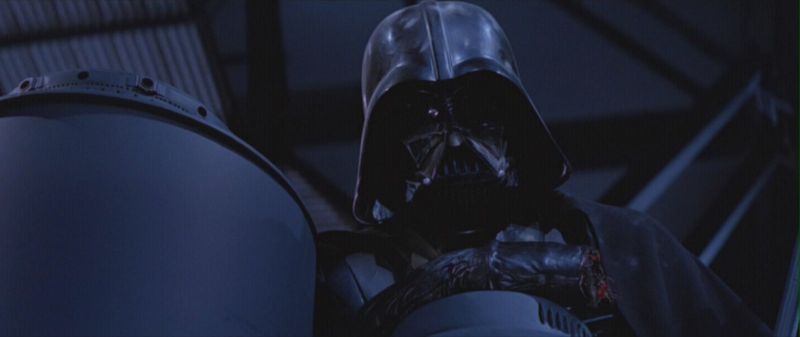
Darth Vader looked on as his former master helplessly tumbled into the gaping maw below. Anakin’s decision had already taken an awful toll, as the Emperor’s uncontrolled Force lightning seared his body and severely damaged the life support systems integrated into his armor.
Inside Anakin’s helmet, a cascade of urgent warnings flashed before his eyes as the suit diagnostics cataloged the damage to its systems. But Anakin knew his armor as if it were a dark extension of his own body. He knew it was salvageable. Despite the pain coursing through him, he knew that his battered body would also endure, as it had for so long. As alarm claxons blared and the mighty second Death Star crumbled around them, Luke was intensely focused on securing their escape.
The two boarded a small shuttle and the boarding ramp hissed closed, muffling the din of the chaos raging outside. Anakin remained in the passenger hold alone as Luke hurriedly prepped the shuttle for takeoff. It was oddly quiet, save for the rhythmic mechanical wheeze of Anakin’s taxed respirator. As the shuttle broke clear of the explosion, Anakin silently wondered what would come next.
Vader just needs a little Windex, a *gently* used replacement mechanical hand, and maybe a gentle exfoliating seaweed wrap and he’ll be as good as new.
What if Darth Vader had survived his showdown with the Emperor and been taken into Rebel Alliance custody? As hilarious as it is to picture Vader waltzing into Bright Tree Village to crash the ewok bonanza, the scenario raises some really intriguing legal issues. Chief among them is the question of how the Rebel Alliance would have handled its newest prisoner of war. Would the former Dark Lord of the Sith be put on trial for war crimes?
Before jumping to the conclusion that Vader would be summarily forced to walk the plank on Mustafar or be sentenced to hard labor at a Tatooine sand factory, it’s worth asking what the Alliance would have done with their newest POW.
Have you been diagnosed with Mesothelioma from burning a Sith lord? You may be entitled to compensation! Call 1-800-WESUEIMPERIALS today!
War is never a pretty business, but there is a long-standing history of holding individuals accountable for violating its laws and customs. Public trials or tribunals are probably the most well known way that the law of war is enforced. Trials and courts-martial for war crimes have been seen throughout nearly every major conflict of the last century, from the Nuremberg trials of World War II to the International Criminal Court at The Hague. Before we dive in any deeper, we’ll go ahead and assume that the Alliance had the capability to put Darth Vader on trial, even if that’s a stretch considering their fledgling nature.
For all the Vader haters out there, putting the Dark Lord on trial for war crimes probably seems like a no brainer. After all, if it weren’t for Vader, Mace Windu would still have a hand, Yoda wouldn’t be living in a mud hut, and all those dear sweet younglings would be…well, still alive. But in reality, Vader’s capture would have come at a seminal point in the galactic war—one that would have made the question of what to do with him incredibly difficult.
At the time of his capture, Darth Vader would have been one of the most hated and feared members of the Galactic Empire. The Alliance long considered him to be one of the highest value targets in the Imperial hierarchy, second only to the Emperor himself. Palpatine’s death by Death Star shaft would have quickly elevated Vader to be public enemy number one. As a result, Rebels of all ranks would have been clamoring to have his helmet on a platter.
In the real world, the fact that someone may have committed war crimes does not automatically mean that they are put on trial. There are always a host of negotiations and debates before anyone steps foot into a courtroom. The Rebel Alliance would be no different, and its leadership would want to discuss Vader’s fate before jumping to any conclusions or analyzing the evidence and case against him.
It is hereby decreed that Frankenstein C-3PO shall be the judge, jury, and executioner of his maker.
As Alliance High Command began its debate over what to do with Vader, Luke and Leia would have quickly found themselves in an impossible position. Both were powerful members of the Alliance with the ability to influence the Alliance’s decision on how to handle Vader.
Luke would have been powerfully compelled to come to his father’s side. Luke’s desire to protect those closest to him was a constant motivator for him, much like his father. Luke had just witnessed his father turn back from the abyss of the Dark Side, only to have his life once again be put on the line as the Alliance considered his fate.
Whether it’s rushing back to the Lars’ Homestead, Cloud City, or Jabba’s Palace, Luke doesn’t exactly have the best track record when it comes to exercising restraint and patience when his friends or family are in danger. When those close to him are in trouble, Luke has a penchant for seeing himself as the savior or protector. The same temptation would have been present with his father’s fate. As the only person who saw Vader kill the Emperor, Luke would have known that he was an essential witness for his father. Anakin could testify to those facts, but there is little chance anyone would believe him given his infamy. In contrast, Luke was a legendary member of the Alliance. When he spoke, others listened and followed. Therefore, in Luke’s mind, he was the key to any scrap of hope for his father.
Leia faced an even more complex choice than her brother. Her loyalty to family would have weighed heavily upon her decision. After learning of Anakin’s survival from Luke, Leia would have been faced her real father for the first time—a man whose armored visage was undoubtedly burned into many of her most terrible memories. Nevertheless, that sudden reunion would have been a great weight upon her shoulders. Luke’s zeal to help would have only increased that weight.
But while Luke had been a member of the Alliance orchestra, fighting in numerous battles, she had been one of its conductors, having dedicated the formative years of her life to helping shape and lead the organization. Her dedication to duty and the Alliance cause would have been an equally heavy weight upon Leia. On one hand, Leia knew that she wielded considerable influence—influence that she could probably leverage in her father’s favor. However, on the other hand, Leia would be keenly aware of the importance of the bigger picture, including the Alliance’s survival and its efforts to end the war. Leia was no stranger to making impossible decisions like this. She faced a similar one on the bridge of the first Death Star when she chose not to betray the Alliance at the cost of her home world.
Leia is the first contestant on the Galactic Empire’s newest gameshow, Deal or No Deal: DEATH STAR Edition
Any temptation to help Anakin would have carried a grave risk for both Luke and Leia. As ROTJ ends, their relationship to Vader was a closely held secret. If either Luke or Leia came to Anakin’s defense, there is simply no way the relationship would have remained hidden. The revelation that they were Darth Vader’s children would have been explosive news. At best, both Luke and Leia would be stripped of their influence in the Alliance. At worst, they would be regarded as spies and traitors.
Luke and Leia would have fully realized that risk and played a limited role in Anakin’s fate as a result. Luke would have realized that he was in a unique position to help both his father and his sister. Luke could stand beside his father and advocate for clemency while not endangering the Alliance’s greater cause. The shock and backlash would be fierce, not unlike what John Adams faced when he came to the defense of British Soldiers involved in the Boston Massacre. However, he could absorb the blows, knowing that he would soon be stepping away from the Alliance to follow his new path as a Jedi.
Meanwhile, Leia could fill a central role in the negotiations without revealing her secret or jeopardizing the fragile Alliance. Her close relationship with Luke was well known, so it wouldn’t be odd for her to call for others to listen to his testimony and pleas. At the same time, her personal experience with Vader’s terror provided a solid counter balance that would have given her credibility as a negotiator. Leia thus could have wielded her influence in the process without risking the greater good.
The feel when you realize that you want to propose to Leia, but you have to talk to her father, the Dark Lord of the Sith about it first.
The Alliance debate would have been equally swayed by other factors. Chief among those would be using Darth Vader to help quickly end the war. While ROTJ may have ended in a big party with space teddy bears, the war was far from over. Recent stories like the Shattered Empire comic, Aftermath trilogy, and upcoming the Battlefront II single player campaign make it clear that the Empire did not simply collapse just because the Emperor died.
Many in the Alliance would see Darth Vader as the linchpin to quickly ending the war. Vader would have been a goldmine of valuable intelligence of all aspects of the Imperial war machine. He also had a mythic reputation on the battlefield. Leveraging his knowledge and fighting abilities could mean a swift end to the fighting, which would have been incredibly tempting.
At the same time, taking any action short of a trial would risk undermining the Alliance’s legitimacy. Restoring justice to the galaxy was one of the Alliance’s core aims. Even if Darth Vader provided substantial help in ending the war, the Alliance would risk fracturing itself if he was not put on trial. Vader cut a wide and deep path of death and devastation during his time at the Emperor’s side. Alliance worlds bearing those scars would not simply stand by while the man responsible was let off. Likewise, many citizens regarded Vader as a symbol of Imperial leadership and oppression. If a man so widely regarded as evil avoided justice, their trust in the Alliance would be shattered. With one decision, the Alliance could lose the support of its members and the citizens of the galaxy they had fought so long for.
VERY IMPORTANT SIDE NOTE: So, did the Rebel Alliance just happen to bring along a bunch of fireworks for the X-Wings just in case they won?
Get those high powered Coruscant criminal defense firms on speed dial, because there is almost no doubt that Anakin Skywalker would have faced trial. Luke and Leia might shape the debate to some degree, but they probably do very little to stem the fervor to hold him accountable. Although Alliance High Command might be open to a bargain in exchange for Vader’s military assistance, they would have no choice but to put him on trial.
Happy Anniversary Star Wars! The Far Away Galaxy from a long time ago has inspired lawyers and judges for 40 years. We recorded three podcasts to celebrate the Ruby Anniversary with friends who all love Star Wars. Join us for lawyers geeking out over why people love Star Wars, legal analysis, and more.
Enjoy, and remember, the Force will be with you. Always.

 Stormtroopers suing for defective body armor would need to prove: that the armor did not perform as expected when used as intended; that the Stormtroopers were harmed; and the failure of the body armor to perform was a substantial factor in causing the Stormtroopers harm.
 There is no evidence of any of these armors failing to protect Troopers from blunt force trauma from melee weapons. However, these Troopers could sue the armor manufacturer under specific conditions. If same ballistic fabric and armor plating was used in all Imperial body armor, the Stormtroopers severing in different deployments could join in a potential class action. Additionally, if the Imperial armor manufacturer had the same warranty printed on each type of armor, then all could join in a prospective class action.
 The Doctrine of Fear