Home Blog

Dooku’s Booty: The Legality of Seizing Count Dooku’s Fortune

0

We may only be a few days into the new year, but Star Wars has already gifted fans with fresh content, as Bad Batch returned for its sophomore season on January 4th. Star Wars legal geeks didn’t have to wait long for some prime galactic legal issues to surface–one was teed up right in the title of Episode 1: Spoils of War. 

After narrowly surviving the Empire’s destruction of all cloning facilities on Kamino, the Bad Batch quickly found themselves back in action with a new mission from Cid–one that promised to bring in more riches than all their prior jobs combined. The mission: Infiltrate Serenno and steal some of the late Count Dooku’s vast fortune while the Empire was busy attempting to seize it for its own use.

Postwar Castle Serenno, home to the galaxy’s largest home furnishings liquidation sale!

The clones arrive on Serenno to find the ultimate estate sale in action, as the newly minted Galactic Empire was rapidly readying Dooku’s valuables to be taken off world. The scale of the seizure is massive, as multiple huge Class Four Container Transports were loaded for bear with mountains of shipping containers filled to the brim with money, jewels, and other treasures from Dooku’s palace. 

Count Dooku, having recently had his head detached from his shoulders via lightsaber, wasn’t in any position to protest. However with the clone wars over, what does international law have to say about this sort of apparently brazen pilfering?

Saying that heads will roll for stealing Dooku’s treasure seems a bit uncouth under the circumstances.

Even though wars end, the laws governing them don’t suddenly cease to exist. The practice of battlefield theft and seizures have endured as long as humans have waged war, from pillaging Vikings to the Nazis’ rampant theft of cultural treasures. The notion of one side taking an enemy’s during or after a war might seem a little unfair, but the law doesn’t treat all wartime takings equally. Although theft is generally outlawed during conflict, there are many circumstances where one side is legally able to take spoils of war from an opponent after a conflict.

When it comes to taking property, International Humanitarian Law (IHL), also known as the law of armed conflict, draws a distinction between private and government property. On one hand, the forcible seizure of private property for personal use, also known as pillaging, is generally outlawed. On the other hand, taking enemy property is generally lawful–a concept known as “spoils of war.” This practice is condoned in IHL treaty law, as the Hague Regulations of 1907 allow an occupying army to take possession of a wide variety of movable property belonging to the occupied State. The legal ability to seize war booty is also recognized under Customary International Law, which is a subset of IHL stemming from long standing accepted international practices and carry the same binding legal effects as treaty law (e.g. Geneva Conventions). 

We’re still awaiting news on the fate of the ultimate prize at Dooku’s castle: The Count’s Exquisite Pajamas

Given Serenno’s key role in the Clone Wars, the Empire’s mission to seize property there had a solid basis in law. Serenno was a key opponent of the Galactic Republic (and by extension the Empire) during the Clone Wars. Having been a core member of the Confederacy of Independent Systems (CIS) at the very heart of the war effort against the Republic, Serenno was a reasonable place for the Empire to look to seize war booty.

But Serenno’s status as a defeated Republic enemy doesn’t automatically mean the Empire could sweep in and take whatever it wanted after the war. The private property of Serennian citizens would be protected from pillage under IHL–a prohibition that would seemingly protect Count Dooku’s fortune. After all, the mere act of participating in a war doesn’t give the enemy a free pass to seize all your personal property outside of the battlefield.

However, Count Dooku was no ordinary citizen–his unique status and role in the war are key to how his property is classified. As the head of House Serenno, Dooku was the political ruler and head of state for the planet–a status that fueled his departure from the Jedi Order. Although Serenno had a planetary council and Galactic Senator, Dooku acted as ruling head of state, serving as the planetary emissary and acting as the planet’s decision-maker in all key areas, including its cessation from the Republic. He was also one of the military leaders of the Separatist war effort, taking a frequent direct role in hostilities. Castle Serenno was the seat of Dooku’s power on the planet and was the location from which he ran planetary affairs (including war efforts). This meant that Dooku’s fortress wasn’t simply a private residence. Based on the circumstances, the castle was effectively government property and thus was fair game for the Empire to search for war booty.

Dooku’s Force ghost watching his palace get lawfully ransacked by his old boss.

Even if Dooku is considered a private citizen, his deep participation in the war effort still renders at least some of his property as war booty. Under IHL, private property that has been used for hostile purposes can also be seized as spoils of war. Dooku was at the heart of the Separatist war effort, using his heavily fortified castle on Serenno as his base of operations. By intertwining his private property with his war involvement, his  actions therefore exposed much of his own private property to seizure.

The Empire was also acting lawfully when it specifically targeted Dooku’s riches for seizure. While war booty is often thought of as items such as weapons or military vehicles, the term encompasses a far greater range of property, including non-military property like money. Under U.S. law, “spoils of war” are defined as “enemy movable property lawfully captured, seized, confiscated, or found…” This is a broad spanning definition that includes a wide range of items, including money. The Hague Regulations provide that an occupying army “…can only take possession of cash, funds, and realizable securities which are strictly the property of the State, depots of arms, means of transport, stores and supplies, and, generally, all movable property belonging to the State which may be used for military operations.” Additionally, under Customary International Law, a party to an armed conflict can seize moveable state property as war booty, including military equipment and even cash.

On Serenno, we see the Empire carrying out a wholesale seizure of Count Dooku’s fortune–piles of credits, jewels, artifacts, and more can be seen inside Imperial shipping containers. These items, particularly the currency, fall squarely within the IHL definition of spoils of war. This wealth was no doubt intertwined with Dooku’s governance of Serenno, including directly funding the Separatist war effort, which effectively rendered it state property eligible for seizure. 

While the Empire’s seizure of Dooku’s booty was generally lawful, it would only be entitled to property that actually belonged to Dooku/Serenno. In the episode, we learn from a Serennian citizen named Romar that Dooku stole untold amounts of his fortune from the Serennian people. How much and what was stolen isn’t known, but stolen property is doubtlessly amongst the items being seized. The Empire has no legal claim to that stolen property, but then again Emperor Palpatine isn’t known for his strict adherence to the rule of law.

I’m sure Dooku would’ve just Venmo’d Palpatine some cash if he’d only asked.

As a group of rogue clones unaffiliated with the Empire, the Bad Batch on the other hand had no legal basis to take any of Dooku’s booty. The right to seize spoils of war rests with a party to the armed conflict, not individual citizens or even individual soldiers taking part in the war.  In either case, the real lesson is that if you find yourself inheriting a vast galactic fortune, think twice before you leave the Jedi Order and start up a massive war you’re destined to lose–otherwise you might lose a lot more than you bargained for (including your head).

Caught in the Net: Imperial Torture in Andor

0

The Galactic Empire is exceedingly good at a few things, from holding the Guinness World Record for using the most black/gray color schemes to allowing the Millennium Falcon to slip through its fingers at only the most opportune moments. Chief among those “accomplishments” is its constant innovation in the field of brutal torture. From the moment the frightening black interrogation droid and its menacing needle floated into Princess Leia’s cell in A New Hope, it has been clear that torturing prisoners is part of the Galactic Empire’s core means of doing business. From Luke to Han, Hera, Kanan, and even poor Chewbacca, the roster of Imperial torture victims is so deep the best question to ask is what prisoner has the Empire somehow not tortured?

Syril confronts Dedra Meero
Unfortunately for Dedra, getting accosted outside work by the creepiest man this side of Alderaan doesn’t meet the legal definition of torture.

Andor showcases one of the darkest examples of this ruthless practice in Season 1, Episode 9 (titled “Nobody’s Listening!”), as Bix Caleen, Cassian’s longtime friend and ally, is brought in for questioning on Ferrix. Following the Rebel raid on the Imperial garrison at Aldhani, the Empire tightens its galactic noose in an effort to identify and destroy Rebel networks. Lieutenant Dedra Meero, ever the dutiful fascist, leads the ISB effort to identify the Rebel agent believed responsible for planning the raid—someone they dubs as “Axis” (whom the audience knows to be Luthen Rael, portrayed masterfully by Stellan Skarsgård). Her efforts lead to the capture of Bix and her colleague Salman Paak, who are hauled in for questioning.

Dedra wastes no time in laying out her demands to Bix, seeking information on Axis, Cassian Andor, and every piece of equipment that she’s had a role in stealing or selling. However, it quickly becomes clear that this will not be any normal interview. Dedra reveals that Salman resisted his interrogation and suffered a terrible fate at the hands of the exceedingly creepy Dr. Gorst. With Gorst lurking in the background, Dedra warns Bix that failure to cough up every bit of information would result in Dr. Gorst taking over. The threat of torture couldn’t be clearer if Dedra had “REFUSE AND YOU’RE GETTING TORTURED…BIG TIME” tattooed across her forehead.

Doctor Gorst smiling in a creepy way
Dr. Gorst: Reigning 12-time champion of the Galaxy’s Creepiest Smile competition.

After Bix shows the slightest bit of defiance, Dr. Gorst steps in and lays out one of the most brutal methods of torture ever seen in the galaxy far far away. Using a specialized headset, Bix is subjected to enhanced recordings of children dying en masse. Gorst explains that the recordings came from the Imperial massacre at Dizon Fray, in which the Empire wiped out the moon’s native sentient species after they resisted construction of an Imperial facility. The Empire discovered that recordings of the Dizonites’ screams while dying possessed unique acoustic characteristics that caused devastating psychological impact on anyone listening. Never one to miss a sadistic opportunity, the Empire weaponized the recordings as a novel method of extracting information from prisoners. Bix is strapped to her chair and subjected to the recordings, almost immediately letting out a primal scream that makes Luke’s yell on Cloud City seem like a tiny mouse squeak.

Imperial torture headset
Just in case you thought “maybe the Empire’s not so bad,” Andor is here to fix that with one little headset.

Before Dedra unleashes Dr. Gorst, she makes clear her belief that Salman and Bix are part of a Rebel cell, describing Bix’s connections with Salman, Cassian, and Axis as a “nest of relationships.” Dedra’s mission is to bring the weight of the Empire down on the nascent Rebellion, destroying Axis and his Rebel network before more damage can be done.

The Rebellion’s struggle against the Empire implicates the real-world Law of Armed Conflict (LOAC), also known as International Humanitarian Law (IHL)—the branch of international law that governs how warfare is conducted. IHL is a large web of treaty, domestic, and customary laws that aim to reign in the destructive effects of war and provide critical legal protections that help reduce suffering.

Before diving into the business of torture, it’s important to assess the type of armed conflict occurring in Andor. Real-world armed conflicts are classified as either “international” or “non-international.” The classification depends on the parties involved in the conflict. International armed conflicts (“IACs”) involve two or more nations fighting each other, such as World War II or the current Ukraine conflict. On the other hand, non-international armed conflicts (“NIACs”) involve a nation fighting an organized non-state armed group (e.g. Iraq versus ISIS), or multiple non-state armed groups fighting each other in a country. The law behind how conflicts are classified is best saved for another article, but how a conflict is classified means a great deal. For our purposes, we’ll consider the Rebellion’s fight against the Empire to be what’s known as a “non-international armed conflict.” That classification determines which provisions of IHL are applicable during the fighting.

There is a big difference in legal coverage between the two types of armed conflicts. IACs trigger the full suite of IHL, including more than 600 treaty rules. Contrastingly, NIACs trigger only a portion of IHL, including fewer than 30 treaty rules. This difference in legal coverage is especially pronounced when it comes to protections for those captured on the battlefield. For example, combatants captured during IACs are generally considered to be Prisoners of War (POWs). While “POW” is a commonly used term, it refers to a key legal status that grants a robust set of protections. There is no such thing as POW status during NIACs, which has huge implications for captured fighters.

An imperial officer smiling sadistically
Nothing brings a smile to Dedra’s face like committing grave breaches of international humanitarian law.

Even though NIACs don’t trigger the full complement of IHL rules, that doesn’t mean there are no protections at all. Both Common Article 3 of the Geneva Conventions (CA 3) and Additional Protocol II to the Geneva Conventions (AP II) provide the bedrock set of rules for NIACs. Those rules include provisions for the protection and humane treatment of prisoners, including addressing torture.

The Rome Statute of the International Criminal Court defines “torture” as:

The intentional infliction of severe pain or suffering, whether physical or mental, upon a person in the custody of the accused.

In the case of Andor, Dr. Gorst’s method of extracting information from prisoners like Bix and Salman absolutely qualifies as torture. The Empire’s use of the recordings to inflict mental suffering is unquestionably intentional. The Empire is fully aware of the serious mental effects inflicted on those who listen to recordings of dying Dizonites. After discovering three of their own officers huddled in various states of emotional distress after listening to the scream recordings, the Empire elected to weaponize the audio for use against prisoners. They even took the additional astoundingly cruel step of isolating a section of audio featuring dying Dizonite children, which apparently has an even more devastating effect on the listener, in an effort to maximize the psychological damage.

Even though Dr. Gorst doesn’t lay a finger on Bix, his intentional infliction of severe mental torment squarely fits the definition of torture. The law recognizes that physical harm isn’t the only method of inflicting suffering upon a prisoner. Infliction of severe mental distress counts as torture the same as any punch, kick, or other physical abuse. The Empire clearly saw the Dizonite recordings as a way to inflict a tidal wave of mental anguish on prisoners in order to quickly get them to divulge information. Here, Gorst and Dedra went above and beyond in their effort to maximize Bix’s mental distress by telling her the disturbing backstory of the recordings and disclosing the awful effects they’d just had on Salman.

The extreme severity of mental suffering caused by the records is immediately apparent, as Bix is in obvious distress. Within seconds of donning the headset, she is sweating, shaking, and lets out a bone-chilling guttural scream. Dr. Gorst fully understands the effects, requiring her to be strapped down and noting that she might not even have the ability to speak while listening. When we next see Bix, she’s laying in a devastated heap on a mattress in her cell after only a short time listening. Under IHL, there is no requirement that torture last for a certain amount of time to qualify as “severe”—here, the Empire was able to inflict an extremely high degree of distress in a short period.

Although IHL differs in many aspects between IACs and NIACs, torture is treated the same across the board. Torture is flatly outlawed in all circumstances under IHL, regardless of the type of armed conflict. Common Article 3 of the Geneva Conventions bans torture outright, including in NIACs. Similarly, Additional Protocol II, Article 4 enshrines its ban on torture as a “fundamental guarantee” for those detained during NIACs. This flat ban reflects the uniform view of the international community that torture has no place in any type of armed conflict. Torture as a practice represents the exact type of needless suffering that IHL is in place to eliminate.

The ISB goes from zero to brutal torture in record time.

Dedra and her stiff-collared ISB colleagues might argue that Bix’s torture was necessary because of an urgent need to identify Axis and gain information about his Rebel cell. However, IHL bans torture without any exceptions. In other words, there is no legal justification for torture. Period. That includes situations where interrogators have a perceived pressing need for information—a scenario commonly played out in movies and TV against the backdrop of some looming major threat (looking at you, Jack Bauer and 24). Simply put, the law of war roundly rejects torture in all circumstances.

That means there is no excuse for the ISB’s use of torture as an interrogation tactic. Even if Bix held a treasure trove of valuable intel, including Luthen’s exact whereabouts, Mon Mothma’s ATM PIN code, and the whereabouts of Luke Skywalker’s juicy personal diary, that still wouldn’t legally justify her torture. Making things worse, Dedra and the ISB seemingly torture Bix and Salman because they want to, not because they think they must due to some existential threat to the Empire. Both Dedra and Dr. Gorst seemingly take twisted pleasure in subjecting Bix to this awful new torture technique.

Even if an exigent security threat justified torture—which is absolutely does not—there is no such urgency at the time Bix is tortured. The raid on Aldhani was long finished by the time Bix is tortured. As Bix is strapped to her chair, the Empire has no actionable intelligence on any imminent Rebel attacks—even the plot against the Imperial power station at Spellhaus isn’t discovered by the ISB until after her torture, following the unrelated capture of a Rebel pilot.

While Dedra is attempting to gain critical intel—Axis’ identity—she also seems determined to inflict severe suffering as a way of maliciously punishing Bix for daring to defy the Empire. Dedra’s arc over the first nine episodes has showcased the caustic and corrupting effects of power, which is on full display as she briefly questions Bix before turning her over to Dr. Gorst. This is exactly the type of sadistic, pointless infliction of suffering that IHL aims to prevent by outlawing torture.

Ever the ambitious evil Imperial officer, Dedra can therefore add “war criminal” to her ISB resume. While the Empire and ISB play by only the laws that suit their needs, the legal ban on torture under IHL remains an enduring protection for those captured on the battlefield.

May the Injustice Be With You: The Jedi Trial of Ahsoka Tano

0

The Clone Wars makes its triumphant return in less than 24 hours, which means we here at The Legal Geeks are bound by law to take up one of the most controversial legal issues in the entire series: The Jedi trial of Ahsoka Tano.

For those in need of a refresher, after a shocking bombing at the Jedi Temple, Ahsoka found herself framed for the attack. Facing accusations of murder and treason, Ahsoka was hauled before the Jedi Council to face judgment. Although the Jedi Order is supposed to be a bastion of truth and justice, those principles seemed to Force levitate right out the window when it came to handling accusations against Ahsoka.


Ahsoka’s trial before the Jedi High Council was a shocking turn of events that saw one of the brightest young Jedi expelled from the Order. It was the first peek into one of the most solemn inner-workings of the Jedi Order, in which Jedi face judgment from their own. Jedi Council members performed multiple roles during the proceeding, including receiving evidence, cross-examining Ahsoka, and rendering a decision on her guilt and future in the Order.

While the real-world military sadly lacks lightsabers, Force levitation, and sweet padawan braids, there is a robust justice system that includes a process very similar to what Ahsoka faced before the Council. Apart from courts-martial, which are criminal trials, a service member can also face a separate adverse administrative process, which can kick them out of the service and strip them of certain benefits.

Real-world Army officers who are accused of misconduct can be forced to appear before a “board of inquiry.” Instead of being presided over by a judge like in a normal criminal trial, a board of inquiry is comprised of three senior officers, whose job is to consider evidence, reach a conclusion about the truth of the allegations, and then decide whether the officer should be kicked out of the service. Much like an actual board, Ahsoka is a Jedi holding the military rank of Commander, which subjects her to judgment before a group of the most senior members of the Jedi Order.

Army boards of inquiry would be far more interesting if everyone was issued a lightsaber and a cool Jedi robe.

Just as the Jedi Council did not criminally convict Ahsoka or throw her in prison, Army boards of inquiry are limited to deciding whether an Army officer should remain in the service. A real-world board of inquiry has no power to hand down criminal convictions, fines, jail time, or other such consequences one might face at trial. Ahsoka’s Jedi trial was similarly limited in its scope, with the Order’s judgment being limited to expelling Ahsoka from the Order, while the possibility of criminal punishment was left to the Republic and everyone’s favorite set of cheekbones, Wilhuff Tarkin.

While Ahsoka’s proceeding was called a “trial,” she very clearly didn’t receive all the rights we afford to defendants. While this doesn’t seem fair, even real-world boards of inquiry don’t give military officers every bit of available due process. Those limited rights stem from the limited scope of the board. Since officers don’t face a criminal conviction or jail time at a board, there is less of a need for robust due process protections.

For example, unlike at a criminal trial, an officer has no Constitutional right to confront the witnesses at a board of inquiry. That means that a witness statement could be used to present certain facts instead of calling that witness to the stand to testify. Since the Jedi Council was only considering expelling Ahsoka from the Order, she similarly had fewer rights than she did at her eventual Republic criminal trial.

Little Known Jedi Fact: Mace Windu also wields a purple gavel at all Jedi Order proceedings.

But before you go give a high five to Mace Windu and a low…low five…to Yoda for offering Ahsoka some due process, it’s important to realize the huge number of problems with Ahsoka’s “trial”—problems which combined to railroad her out of the Order.

Even though military officers don’t get every bit of due process protection at a board, they still enjoy some protections, which are key to ensuring a fair and impartial process. One of the biggest problems with Ahsoka’s trial is her lack of defense counsel. Unlike Ahsoka’s subsequent Republic trial, where she is deftly represented by Padmé (who may face her own charge of practicing Star Wars law without a license), she faces the Jedi Council without the benefit of an attorney. Even though Anakin Skywalker accompanies her to the proceeding, he plays no role—except for nearly starting a brawl with the Temple Guards after the verdict is handed down.

A trained and experienced defense counsel would have almost certainly helped her case. Military officers are assigned a military defense counsel to represent them before a board of inquiry. The counsel plays a critical role in protecting the officer, from helping prepare the case to questioning witnesses and presenting arguments. It’s unclear whether the Order has any trained Jedi attorneys (totally unbiased opinion: they ABSOLUTELY should), but assigning Ahsoka a more senior Jedi like Tera Sinube or Cere Junda to her case would have almost certainly helped. Where Ahsoka seemingly struggled to present her case to skeptical Council members, a more senior Jedi could have better broken through some of that bias by leveraging their own reputation and experience.

Yelling and beating up Temple Guards doesn’t count as expert legal advocacy, Anakin.

The lack of impartiality amongst the Council is another massive shortcoming of Ahsoka’s trial. Real-world boards of inquiry are comprised of senior officers who are required to be impartial and detached from the allegations. In most cases they do not know the accused officer and have no prior knowledge of the allegations. Before the board begins military defense counsel have the ability to question the officers on the board about their possible biases or preconceived notions, similar to how jurors are questioned before a criminal trial. If a board member is biased, the accused officer can challenge a board member and potentially get them replaced.

In Ahsoka’s case, the Jedi Council members who sat in judgment were about as far from impartial as you can get. From Plo Koon, who had known Ahsoka since discovering her on the planet Shili, to Obi-Wan Kenobi, who had served extensively alongside Ahsoka in combat, each of the Council members knew her intimately. Even though some of the Council’s prior relationships likely colored opinions in Ahsoka’s favor, those relationships nonetheless would have made it extremely difficult for Council members to remain fully impartial.

However, it is the Council’s prior knowledge of the case that posed one of the biggest issues. In the real world, board members have zero or very little prior knowledge of the case. This is by design, as it allows them to hear evidence without preconceived notions or opinions. It is then up to the military attorney prosecuting the case the present the facts to the board through witnesses and other evidence. In Ahsoka’s case, the Jedi Council had perhaps more prior knowledge about the case than any other Jedi in the Order. From the immediate aftermath through the investigation, the Council was kept informed of virtually every detail of the case. This information clearly colored their judgment, as Council Members like Mace Windu weaponized their pre-existing knowledge to pointedly cross-examine Ahsoka.

Moreover, their deep emotional connection to the case undoubtedly compromised their judgment. The attack itself represented a brazen and deadly assault on the home of the Jedi and the Council. The loss was clearly felt deeply by the Council, who attended the funeral of the Jedi killed in the attack, with Yoda delivering a stirring eulogy for the fallen. While Jedi might generally pride themselves on their lack of attachment, the pull of this connection was on display during the trial, with Council members seeming to care more about assigning blame than about a legitimate search for the truth. Forcing Ahsoka to plead her case before such a deeply biased and partial body virtually guaranteed her expulsion from the Order.

Jedi Council Schedule: 10am-Attend funeral of bombing victims; 12pm-Lunch at the Jedi Cafeteria; 1pm-Sit in judgment of the person accused of killing the victims.

As if Ahsoka didn’t face enough of an uphill battle, the actual conduct of the trial was rife with unfairness. While the Jedi Council took their time to conduct a relatively extensive investigation, Ahsoka was barely afforded any time to prepare for her trial. An actual military officer would receive advance notice of the board, which gives them a meaningful opportunity to prepare a defense. Ahsoka is given none of that time or access to evidence, and is instead hastily brought before the board and forced to slap together a case.

The lack of time for preparation is a serious problem given how evidence is presented at Ahsoka’s trial. In a normal military board proceeding, there is no presumption of guilt. The Army as an organization bears the burden of proving the allegations and persuading board members to kick the officer out of the service. An attorney for the government is assigned to present evidence and make arguments in order to prove the Army’s case.

The Jedi Order turns that concept on its head. Rather than sit and hear a complete set of evidence, Council members walk in having made a range of assumptions about certain facts. The end result is Ahsoka being forced into the deeply unfair position of having to prove her own innocence. Without the ability to have counsel or line up favorable witnesses, she is also forced to give up her right to remain silent, which is something actual officers are entitled to. Given the possibility those statements could be used against her at a separate criminal trial, this put Ahsoka in a precarious position.

The most appalling injustice of Ahsoka’s trial: Not giving her so much as a three-legged stool to sit on during the proceedings.

The degree to which the deck was stacked against Ahsoka became readily apparent as the Council rendered its verdict. After taking almost no time to hear evidence or allow Ahsoka to present her case, Yoda announced that the Council had already reached its verdict. Under normal circumstances, members of a board would deliberate over the evidence in private, much like a jury in a criminal case. Here, the Council devoted exactly zero minutes to deliberation before delivering its pre-cooked verdict. Anakin immediately recognized how unfair the circumstances were, calling out the Council and nearly starting an epic battle royale with Temple Guards in the trial chamber.

In the end, the Jedi Order offered about as much due process to Ahsoka as Jabba the Hutt gave Han before trying to throw him in the sarlacc pit. For an organization that prides itself on wisdom, knowledge, and justice, the Jedi Order displayed a shocking lack of those qualities in its treatment of Ahsoka. The Jedi Council’s knee-jerk lunge towards quick justice is symbolic of the larger fracturing of the Jedi Order under the stress of the Clone Wars.

The Galaxy’s Greatest Son: Kylo Ren’s Inheritance

0

The Rise of Skywalker nearly is upon us and Star Wars fans worldwide are clamoring for answers to the questions that have plagued us since The Last Jedi. While things like the fate of the Resistance and Palpatine’s mysterious return are no doubt important to many, there is one question that stands above all others: What will Kylo Ren’s inheritance be?

With the love of estate planning being so prevalent amongst Star Wars fans, it’s time to give the people what they really want by taking a look at what the galaxy’s #1 son stands to inherit as the Skywalker Saga concludes.

What parent wouldn’t want to leave their things to such a doting and well-adjusted son like Kylo?

Kylo first found himself in a position to possibly receive inheritance at the start of the sequel trilogy. Kylo’s life was suddenly turned upside down towards the end of The Force Awakens when his father, Han Solo, suddenly died of a tragic lightsaber wound.

When someone dies (even on a far away planet that is also a superweapon), a legal process known as probate is used to settle the decedent’s (dead person’s) debts and to ensure their property is transferred to heirs and beneficiaries in an orderly fashion. A specialized type of court, known as a probate court, is typically involved in this process, with the goal of overseeing the administration of estates.

Even though Han wasn’t exactly in the best financial position at the time of his death, he still had assets to his name. From the reclaimed Millennium Falcon to his trusty DL-44 blaster, Han owned a decent amount of property at death, which would need to be distributed during the probate process.

The law generally requires that you outlive someone in order to inherit from his or her estate. Leia and Kylo, as Han’s surviving spouse and child, would therefore both be in position to be beneficiaries of Han’s estate.

“This is NOT how I thought this day was gonna end.”

The first step in the probate process is determining whether Han died with a will. A will is a key part of the probate process, since it’s the document in which a person expresses how his property should be distributed after he dies. As someone who lives out of his spaceship and illegally hauls rathtars around the galaxy, it’s safe to say that Han probably never took the time to sit down a and draft a will.

When someone dies without a will, a set of default laws kick in. Known as intestate succession laws, these laws apply equally to anyone who dies without a will. In the absence of a will to provide clear directions, intestate laws operate to ensure an orderly distribution of an estate that minimizes fighting amongst heirs. These laws establish both who is eligible to inherit from an estate, as well as setting their respective shares.

For example, in Pennsylvania, in the case of a person who is survived by both a spouse and a child of that marriage, the spouse inherits the first $30,000 of the decedent’s property, plus half of the remaining balance, and the child inherits the rest. Han’s family fits that profile, meaning Leia and Kylo would potentially stand to inherit a decent chunk of Han’s estate.

Kylo can’t wait to hang his dad’s lucky sabaac dice over the rearview mirror of his command shuttle.

But before Kylo can tear off in the Millennium Falcon to do space donuts, he’ll have to deal with a major legal speed bump to his inheritance claim. That legal hiccup arises because of how Han died. Kylo isn’t in a position to inherit from his dad because of some unfortunate accident or a sudden deadly illness—he murdered his father in cold blood. If it seems patently unfair that someone might stand to inherit from his own misdeeds, that’s because it absolutely is.

Fortunately, just about every state has legal mechanisms in place to prevent these types of ill-gotten gains. Commonly known as “slayer statutes,” these laws prevent someone who killed the decedent from inheriting from the victim’s estate. Slayer statutes accomplish this by treating the slayer as having died before or “predeceased” the victim, which effectively bars them from inheriting any property. One of the most famous examples of a slayer statute in action came with the Menendez Brothers in the 1990s. Lyle and Erik Menendez, heirs to a $14.5 million dollar estate, brutally murdered their parents in 1989. They were later convicted in a high profile trial and barred from inheriting the lucrative estate.

In Kylo’s case, he would almost certainly be classified as a “slayer” under the law in most states. In Pennsylvania, a slayer is defined as “any person who participates, either as a principal or as an accessory before the fact, in the willful and unlawful killing of another person.” Kylo was a principal in the death of Han, having willfully run him through with a lightsaber on Starkiller base.

Obliterating property of the estate just because you can’t inherit it is never the right answer.

Although Kylo might cry foul that he hasn’t been tried and convicted of Han’s death, that wouldn’t matter in most states. While a criminal conviction for murder is often treated as conclusive proof that someone is a slayer, a typical slayer statute does not require a criminal conviction. That’s because these statutes are civil laws, not criminal laws, which means the burden of proof is much lower. Kylo’s responsibility for Han’s killing would therefore only need to be shown by a preponderance of the evidence, as opposed to being proven beyond a reasonable doubt. Thus, if the court concluded that it was more likely than not that Kylo killed Han, he would be blocked from any inheritance. Given that there were two eyewitnesses to the crime (three if the court can find a wookiee interpreter for Chewbacca to testify), that burden of proof would be easy to meet.

Kylo might also argue that he isn’t a slayer because he wasn’t criminally responsible for Han’s murder, perhaps by reason of Dark Side induced insanity. But despite that argument, he might still be barred from any inheritance in certain states. For example, in Florida, the definition of a slayer is much broader, including those who unlawfully kills or merely participates in procuring the death of someone. That expansive definition includes crimes that go beyond premeditated murder, and arguably includes lesser unlawful killings such as involuntary manslaughter.

Unfortunately for Kylo, his eagerness to prove himself to Snoke likely doomed his chances at any inheritance. Kylo won’t even stand to inherit a single one of Han’s dusty old vests (which are no doubt covered in Chewbacca hair).

This is the Way: Refugees with Jetpacks

0
Don’t say the Guild didn’t warn you…

At first glance, Mandalorians might not seem like a desperate lot, what with all their blasters, flamethrowers, whistling birds, heavy repeating cannons, jet packs, and…well you get the idea. But behind those steely beskar helmets are a people fighting for their very existence in the galaxy far far away. The first few episodes of The Mandalorian have given us a very different look at Mandalorians.

A far cry from what we’ve previously seen of their society in The Clone Wars or Rebels series, Mandalorians have been driven into the shadows by the Empire, forced to hide like sand rats. But with the fall of the Empire, could the Mandalorian people lawfully claim refugee status in order to get protection from the New Republic?

Let’s all agree that Baby Yoda would be granted INSTANT asylum in every single household in the Star Wars galaxy.

Unfortunately for Mandalorians, escaping persecution in the galaxy probably isn’t as easy as planting a sweet Mythosaur flag on a new planet. Even though The Mandalorian takes place several years after Return of the Jedi, it’s clear that the entire galaxy hasn’t suddenly become a friendly place after the Empire’s fall, especially for certain groups like the Mandalorians.

From mopping up Imperial warlords to establishing a credible new government, the New Republic undoubtedly had a large set of priorities competing for its limited resources.   However, given the huge numbers of people displaced by the galactic civil war, the work of crafting a legal framework to govern refugees and asylum seekers would likely have been a top priority for leaders like Mon Mothma.

The basic judicial legal concept of asylum dates back millennia. It allows those persecuted by or within their own country to seek sanctuary and protection from another sovereign authority. Over time, countries have developed their own unique refugee and asylum laws, which means legal standards differ depending on which country you’re seeking refugee status in. For example, under Australian law, those who attempt to travel illegally by boat to the country will not be processed or resettled in Australia. Intended as a measure to stop human smuggling, those arriving illegally by boat may be returned to international borders or sent to a third country for processing. Elsewhere, in Brazil the granting of asylum is a principle enshrined in the country’s constitution.

We don’t know precisely what galactic laws are on the books at the time of The Mandalorian (Lucasfilm ought to give us the Star Wars legal drama we deserve), so we will have to fill the gap with real world law. To that end, we will use U.S. refugee and asylum law as a guide.

By the end of the massive gunfight at the end of Episode 3 (The Sin), the Mandalorians had probably blown their welcome on that particular planet to smithereens. The Mandalorian seemingly confirms this, telling his hulking brother in arms that the Tribe would be forced to relocate to another planet. Since they would be seeking sanctuary on another planet from outside its borders, the Tribe would therefore be considered refugees, assuming they meet that legal definition.

Destroying literally everything in sight isn’t the ideal way to endear yourself to local officials.

Before the Mandalorians can go plop down their jet packs on a new planet, they would bear the burden of proving they are entitled to refugee status. Under the Immigration and Nationality Act (“INA”), a refugee is defined as any person outside their own country who is unable or unwilling to return there because they have suffered past persecution or has a well-founded fear of future persecution on account of race, religion, nationality, membership in a particular social group, or political opinion.

The Tribe has clearly been displaced from their home on Mandalore, having resorted to hiding out on a dingy backwater planet. Historically, Mandalorians were a very territorial people who fiercely defended their independence from the larger galaxy. Given Mandalorians’ deep connection to their home, it’s incredibly unlikely Mandalorians would voluntarily choose to live off world en masse. The Mandalorian’s conversation with fellow Tribe members back this up, making it clear that they were driven into hiding by the Empire.

We know from the Rebels series that Mandalorians still occupied their planet in some form within a year of the Death Star’s destruction in A New Hope. The Tribe speaks of a major event occurring some time after that point which was seemingly the catalyst that drove Mandalorians from their home. While we don’t yet know a great deal about this event, it is referred to as the Great Purge. That apparent atrocity ultimately scattered surviving Mandalorians and sent them into into hiding. This means the Tribe could certainly prove that it suffered past persecution that displaced them from Mandalore.

Since the Great Purge was inflicted upon the Mandalorian people, they also have a strong case that the persecution was on account of their nationality or religion. Nationality is traditionally based on one’s citizenship. As citizens of the sovereign planet Mandalore, ‘Mandalorian’ could be considered a nationality in the same way we recognize a legal difference between U.S. and French or Italian citizens.

However nationality isn’t defined only by one’s citizenship. Persecution of ethnic, linguistic, and cultural groups within a population can also be deemed persecution based on nationality. The persecution of ethnic minorities within their own borders is often considered persecution based on nationality. The Chin people of Myanmar are a good example of this principle.  While the Chin are technically citizens of Myanmar, the targeted persecution of their group has been considered persecution based on nationality. Much like the Chin, Mandalorians would likely constitute their own ethnic subgroup of the larger galaxy, given their unique common culture that includes a religious devotion to weapons and fervent dedication to not removing their helmets. The Empire’s targeted mass murder of Mandalorians would therefore qualify as persecution based on nationality.

Who says a refugee can’t have a heavy repeater blaster and jetpack?

But it is not enough to have simply been persecuted in the past. Proving that they are unable or unwilling to return to Mandalore on account of that persecution is a much tougher legal hurdle for the Tribe. By the time of the show the Empire and its military had long since been dismantled, which means the major threat to their existence had arguably been neutralized.

In response, the Tribe would argue that the Imperial military hasn’t been fully swept away, particularly in the far reaches of the galaxy. We’ve seen evidence of this so far in the show, with The Client commanding a number of Imperial troops. Mandalore similarly lies in the Outer Rim, far from the reach of New Republic authorities, which makes it plausible that a dangerous Imperial remnant still operates there. Simply alleging that Imperials are likely still operating around Mandalore would not be enough to meet their legal burden. It would be incumbent upon the Tribe to offer tangible evidence of the threat posed by Imperial remnant forces.

With the New Republic now governing the galaxy, Mandalorians would also need to prove that the government was unwilling or unable to protect their people. Under the INA, an applicant must show more than the government’s mere difficulty in controlling private behavior, such as that of Imperial remnant forces. Similarly, the mere fact that a country has problems effectively policing certain crimes is not enough to qualify one as a refugee. Considering the devastation Mandalore endured at the Empire’s hand, the Tribe might present evidence that Mandalore’s government remains in tatters following the galactic civil war, with no organized law enforcement or military force in place to protect its citizens.  Presenting the planet as a lawless place with a completely defunct government would make for a powerful argument in favor of refugee status. The Tribe could present a similar argument about the New Republic, who clearly lack the resources to do much outside the Core.

With so many unanswered questions about Mandalore, the Tribe’s legal fate rests on their ability to fill in those gaps in evidence. My personal legal advice would be to forgo the time consuming refugee process and instead mount the sort of massive Mandalorian assault to retake the planet that we’re all dying to see.

The Disintegration Defense

0

Jawas: Disgusting creatures who a certain golden protocol droid can’t abide.  C-3PO’s opinion of Jawa cleanliness aside, their reputation as enterprising scavengers is legendary in the galaxy far far away.  However, Jawas don’t always acquire their treasured junk in strictly the most legal of ways.  In the second episode of The Mandalorian, the Mandalorian learns firsthand about the Jawas’ preferred procurement method: Brazen theft.

After securing the cutest bounty in the galaxy, our intrepid…hero?…makes the long trek back to his ship, the Razor Crest, only to find it being ransacked and stripped clean by a group of Jawas.  With his only ride off the planet being disassembled before his very eyes, the Mandalorian does what any well-adjusted member of a galactic warrior race would do: He opens fire with his rifle, disintegrating several of the diminutive thieves.

Despite being one of the funniest scenes in recent Star Wars history, could the Mandalorian resort to deadly force to protect his ship?

Darth Vader should have ABSOLUTELY allowed disintegrations in The Empire Strikes Back.

At first glance, the Mandalorian seemingly has a compelling case for opening fire on the Jawas.  He’s on a dangerous planet escorting a relatively defenseless baby and suddenly finds himself outnumbered by the Jawas, who are clearly armed and in the middle of committing a brazen crime.

But under the law you unfortunately can’t just disintegrate your way out of all your problems.  When it comes to using deadly force, the law is especially restrictive, limiting the circumstances in which you can kill another person.  These rules are in place for a good reason, since we don’t want armed citizens running around acting like Han Solo in the Mos Eisley Cantina.

Virtually every state in the U.S. allows the use force to protect yourself or another person.  However, given the high value placed on human life, the use deadly force is considered a last resort.  For example, in Pennsylvania, you may use deadly force to defend yourself or another if you reasonably believe that such force is necessary to prevent great bodily harm or death.  That reasonable belief requirement sets an intentionally high bar for using deadly force.

Here, even though the Mandalorian was heavily outnumbered and had a small (adorable) alien baby in tow, he wouldn’t be able to convincingly argue that he disintegrated in self-defense.  Before opening fire, he was a good distance from the Jawas to the point that he needed to use a scope to see what they were up to.  While some of the Jawas may have been armed, they carried short range ion weapons and were not firing towards him.  In fact, the Jawas don’t make any threatening moves toward the Mandalorian until he starts his disintegration spree.  It’s therefore going to be nearly impossible for the Mandalorian to claim some form of self-defense to justify his actions.

The Mandalorian graciously went straight Oprah on the local Jawa clan.

But what about defending the Razor Crest?  It’s clear that the Mandalorian isn’t vaporizing poor Jawas because he thinks he’s in danger, he does it in order to protect his ship.  On it’s face, this reaction seems rational.  After all, he manages to catch the Jawas in the act of stealing a large amount of his property, including items from within his ship and large chunks of the ship itself.  More importantly, the Razor Crest is his only way off the dangerous planet.  Given those factors, shouldn’t he be able to protect it at all costs?

Although those are seemingly compelling reasons to use deadly force, the Mandalorian is stepping into some serious legal poodoo by doing so.  While the law recognizes the inherent value in defending life, the idea of hurting or killing another person over a piece of property simply isn’t acceptable or legal in most places.  In fact, only Texas law allows the use of deadly force to protect tangible movable property.  That means that in 49 out of 50 states, it wouldn’t matter how valuable or important the Razor Crest is—disintegrating Jawas to protect it would not be a justified killing.

Even if Arvala-7, the planet shown in episode 2, uses a version of Texas law (which, given what we’ve seen of the planet, isn’t so far-fetched), the Mandalorian would still be in hot water.  Despite its permissive nature, Texas law still has restrictions on the use of deadly force to defend property.  Although Texas law allows the use of deadly force to prevent the commission of a theft, it requires that the theft be at nighttime.  That fact might seem like a minor technicality, but it’s an important limiting factor in the statute.  While I’m no expert in the planetary day/night cycle of Arvala-7, the Mandalorian confronts the Jawas in broad daylight.  That means not even the law of the great state of Texas will protect the Mandalorian in this scenario.

All judges shall henceforth be required to work this quote into all hearings and trials.

Given the Mandalorian’s serious legal predicament, he can only hope that he gets a judge like C-3PO, whose disdain for Jawas clearly outweighs his commitment to law and order. Alternatively, the New Republic could rally around a change in the law, making for deadly force to defend property, so long as it is done hilariously by way of disintegration.

Han Solo: Deserter Extraordinaire

0

SOLO SPOILER ALERT:

Don’t say we didn’t warn you, kid. Solo spoilers follow below.

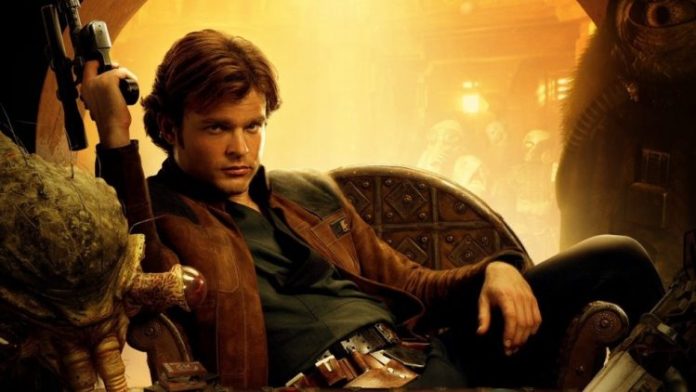
Before Han Solo ever shattered the Kessel Run record, shot poor Greedo, or teamed up with cuddly Ewoks to fight the Empire, he was a lowly Corporal in the Imperial Navy. Han stamped his ticket off his home planet of Corellia by enlisting in the Imperial Navy. After getting kicked out of the Imperial Academy on Carida, Han was reassigned to glamorous duty as an infantryman and got sent to slug it out in the mud on Mimban. Despite getting such a choice assignment, Han decides to walk away from Imperial military service to join Beckett’s band of miscreants.

“Deserter” is a military criminal term that has worked its way into our everyday language—it has even officially made its way into Star Wars films, starting in The Force Awakens with Finn. In reality desertion is a complex and serious crime that is unique to the military, which makes it worth asking whether Han’s actions in Solo really amount up to a violation of military law.

It’s a well-known fact that Imperial JAG prosecutors and their impeccably crisp accents are far more feared than THE BEAST.

In its simplest form, desertion is the act of leaving one’s post without authority. Desertion is the bigger, badder brother of absence without leave (more commonly known as AWOL), which is a separate crime. The key difference between the two crimes is that desertion requires proof of intent to remain away permanently.

Militaries around the world have been dealing with soldiers running away from duty for centuries. The United States military certainly hasn’t been immune to the problem, having dealt with deserters as far back as the Revolutionary War. Over 200,000 men deserted from the Union Army in the Civil War. In World War II, the military tried and sentenced roughly 20,000 deserters. Real world desertions have continued despite the transition to an all volunteer fighting force, with roughly 5,500 service members deserting in 2003-2004, just after the invasion of Iraq.

Several famous faces have had brushes with these crimes, including General George Custer and The Great Escape actor Steve McQueen, who were both punished for AWOL stints involving running off to see a special woman in their lives (sound familiar, Han?). Given the Imperial military’s sheer size, its penchant for forcing citizens into service, and the inherent danger of service, it’s a no brainer that the Empire probably has its fair share of desertion and AWOL problems.

“TK-421 thought his unauthorized vacation to Felucia was more important than his squad mates. Now the Death Star is blown up and it’s all his fault.”

Desertion is a crime unique to the military that stems from the nature of military service. For the average worker, if you don’t show up to work you might get fired, but you won’t get hauled into court or tossed into a filthy pit with THE BEAST. Instead, someone else gets hired to fill your place and the world keeps spinning. However, unlike most civilian jobs, service members can’t simply walk off the job, quit, or refuse to do something.

The basic nature of military service means forfeiting a measure of free will. In today’s volunteer force, service members sign contracts that obligate them to serve for a particular period of time. During that time, you are legally bound to obey the orders of your superiors until you are lawfully discharged from service. My own active duty service provides a perfect example of this give and take: Back in 2012 I had plans to attend the big Star Wars Celebration convention in Orlando. My tickets, airfare, and hotel were all locked in and I was all set to go…until I received orders to deploy to Afghanistan. Even though I desperately wanted to go to the convention, my military obligations sadly trumped Star Wars. Having voluntarily enlisted in the Imperial Navy, Han was similarly obligated to serve out his time until discharged.

The look of an Imperial service member who is ECSTATIC to serve the benevolent Emperor.

Desertion is one of the most serious crimes under the Uniform Code of Military Justice (UCMJ), which is the body of law that governs each military branch. Desertion in a time of war can be charged as a capital offense, meaning that the death penalty can be imposed. That tough approach is tied directly to the huge negative impact desertions can have on military units and their ability to effectively fight.

To prove desertion under Article 85 of the UCMJ, the following elements must be satisfied:

  1. The accused absented himself from his unit, organization, or place of duty;
  2. That the absence was without authority;
  3. That the accused intended to remain away permanently; and
  4. That the accused remained absent until a particular date alleged.

I’ve got a bad feeling about Han’s chances at beating a desertion charge. When Han decides to join up with Beckett and Val, he is still assigned to the Imperial 224th Armored Division “Mud Jumpers,” who have been deployed to pacify Mimban (a planet that probably totally deserved to be invaded by Imperial forces). Han absents himself from his unit and his assigned place of duty on Mimban by hopping aboard the stolen AT-Hauler and flying off planet, thereby satisfying the first element.

Han clearly had no authority to leave Mimban. When most civilians leave work, their time is their own. However, service members are generally considered “on duty” at all times, even after hours. Absences such as vacations (commonly called “leave”) or R&R from a combat zone must be specifically approved by commanding officers. In Han’s case, he doesn’t have any authority to leave his unit. In fact, just before joining up with Beckett, Han’s commanding officer had issued orders for his unit to move out for the southern marshlands. Han wasn’t given any authorization to leave the campaign or the planet, which means that the second element is met.

Unfortunately for Corporal Solo, he is lawfully bound to take orders from many, many other people.

The third element of desertion involves proof of the accused’s specific intent. This element is often a tricky one, because it involves proving a person’s internal thought process. However, you don’t necessarily need a confession to prove one’s intent to desert. Under the UCMJ, evidence of one’s intent to remain away permanently can be drawn from a wide variety of circumstances, including the length of the absence and statements and actions of the accused. Han arguably provided ample evidence that he never intended to return to Imperial military service. Han not only walked away from his unit, but he completely jumped planet, running light-years away to the Mid-Rim planet of Vandor. This would be akin to a real service member leaving his post in Georgia and turning up in South America, and it constitutes strong evidence of his intent.

Moreover, Han’s actions in committing crimes against the Imperial military, from aiding in the theft of the AT-Hauler to the brazen robbery of the Imperial Conveyex train, strongly suggest that he intended to remain permanently away from service. After all, Han had every opportunity to surrender to Imperial authorities in both instances, but instead chose to remain on the run. Han also manages to blatantly admit to his intent when he tells Beckett that he’s already a deserter. Thus, Han’s actions and his own big mouth amount to substantial proof of the third element.

The final element, which requires that a closed period of desertion be alleged, would ultimately be satisfied after Han was captured and charged.

Sadly, the UCMJ does not currently recognize the “It’s not my fault” defense.

Unfortunately for Han, the odds of him being acquitted of desertion are approximately 3,720 to 1. Even though Beckett was right that the Empire doesn’t send out enforcers to track down deserters, the crime would permanently hang over Han’s head, as the statute of limitations is “tolled” (pauses) while someone is absent without authority. For Han, that means having to live life with Jabba’s fat bounty on his head and the ever present prospect of an Imperial court-martial. That’s what I call being in deep bantha poodoo.